Ecommerce API Integration — A Strategy, Not Just Plumbing in 2026
Ecommerce API integration is more than calling endpoints. REST or GraphQL, webhooks, rate limits, retries, auth, versioning — the choices you make on reliability and security decide whether an integration runs quietly or breaks loudly.
Ecommerce API integration is how modern stores connect to everything — ERPs, payment gateways, shipping, marketing tools, marketplaces — and it is far more than “call the endpoint and parse the response”. The difference between an ecommerce API integration that runs quietly for years and one that breaks under load, loses data or gets rate-limited into failure comes down to a set of strategic choices: REST or GraphQL, webhooks or polling, how you handle retries and failures, how you secure credentials, how you cope with API changes. Treating API integration as a strategy rather than plumbing is what separates robust integrations from fragile ones. This guide covers the decisions that matter.
Search intent: informational/technical — developers and technical leads building or reviewing API integrations. We cover why it is strategic, REST versus GraphQL, webhooks and reliability, auth and security, and getting it right. It builds on our WooCommerce REST API authentication guide and ERP integration guide.
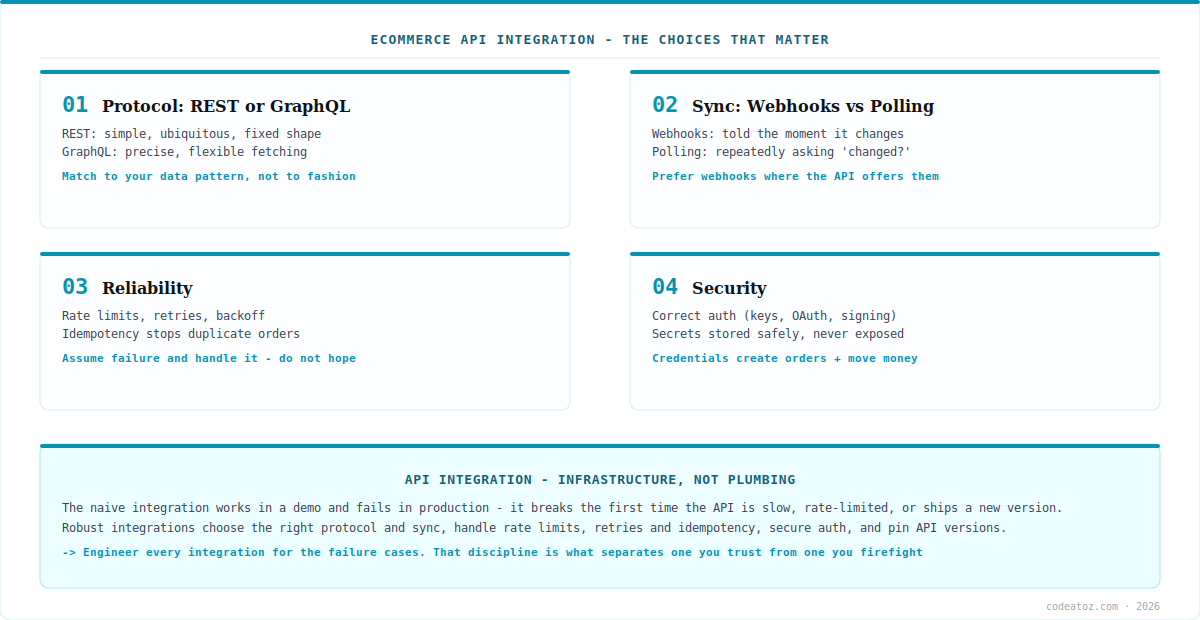
Ecommerce API Integration: Why It Is Strategy, Not Plumbing
The reason ecommerce API integration deserves to be treated strategically is that the naive version — write code that calls an API and processes the result — works in a demo and fails in production. Real APIs impose rate limits, go down temporarily, change over time, return errors, and hold data you need to fetch efficiently. An integration that ignores these realities is fragile: it breaks the first time the API is slow, hits a rate limit during a busy period, or silently stops working when the provider ships a new version.
A strategic ecommerce API integration, by contrast, anticipates all of this. It chooses the right protocol for the data access pattern, uses the right mechanism to stay in sync efficiently, handles rate limits and transient failures gracefully, secures its credentials properly, and is resilient to API changes. None of these are exotic — they are well-understood practices — but skipping them is exactly why so many integrations are brittle. The decisions below are what turn ecommerce API integration from hopeful plumbing into dependable infrastructure.
Ecommerce API Integration: REST vs GraphQL
A foundational choice in many an ecommerce API integration is REST versus GraphQL, where both are offered. REST exposes resources at endpoints and is simple, ubiquitous and well-understood — you call an endpoint and get a fixed response shape. GraphQL lets the client specify exactly what data it wants in a single query, which can be far more efficient when you need specific fields across related objects, avoiding the over-fetching (getting more than you need) and under-fetching (needing multiple calls) that REST can cause.
Neither is universally better for ecommerce API integration; they suit different access patterns. GraphQL shines when you need flexible, precise data fetching — pulling exactly the fields you want, especially across related data, in one request. REST shines in its simplicity and universality, and is often perfectly adequate, particularly for straightforward operations. Many modern ecommerce platforms offer both (our guides on the Shopify GraphQL Storefront API and WooCommerce REST endpoints show each). The right choice in your ecommerce API integration depends on your data access pattern: reach for GraphQL when precise, flexible fetching matters, and REST when simplicity serves. Do not choose on hype; choose on how you actually need to read and write data.
Ecommerce API Integration: Webhooks and Reliability
How your ecommerce API integration stays in sync is a decision with big reliability implications. The two models are polling (repeatedly asking the API “has anything changed?”) and webhooks (the API notifying you when something changes). Webhooks are generally far more efficient and timely — you get told about a change the moment it happens, rather than discovering it on your next poll — and they avoid wasting rate limit on empty checks. Where an API offers webhooks (as many do, like the Shopify webhook API), they are usually the better foundation for a responsive ecommerce API integration.
Reliability is where strategy matters most. Real ecommerce API integration must handle rate limits (back off and retry rather than hammering the API into rejecting you), transient failures (retry with sensible backoff, do not give up on the first error), and idempotency (ensure a retried request does not create a duplicate order). It should queue work when a system is down and process it when recovered, and log and alert on failures so problems surface quickly. These reliability practices — retries, backoff, idempotency, queueing, monitoring — are the difference between an integration you trust and one you constantly firefight. A robust ecommerce API integration assumes things will go wrong and handles them, rather than assuming a perfect world.
| Concern | The naive way | The strategic way |
|---|---|---|
| Data fetching | Over/under-fetch with REST | Match REST vs GraphQL to pattern |
| Staying in sync | Constant polling | Webhooks where available |
| Rate limits | Hammer until rejected | Back off and retry |
| Transient failures | Give up on first error | Retry with backoff |
| Duplicate risk | Retry creates duplicates | Idempotency keys |
| API changes | Breaks silently | Version pinning + monitoring |
Ecommerce API Integration: Auth, Security and Getting It Right
Security is non-negotiable in ecommerce API integration, because API credentials are keys to your data and often to actions with real consequences (creating orders, moving money). Authentication must be done properly — using the API’s intended auth mechanism (API keys, OAuth, signed requests) correctly, as our authentication guide details. Credentials and secrets must be stored securely, never hard-coded in source or exposed to the client, and rotated when needed. An ecommerce API integration that leaks or mishandles credentials is a serious security incident waiting to happen.
Getting ecommerce API integration right, then, is the sum of these strategic choices: pick REST or GraphQL by access pattern, prefer webhooks for efficient sync, build in rate-limit handling, retries with backoff and idempotency, secure your auth and secrets properly, and guard against API version changes with pinning and monitoring. Also apply the same ownership-and-direction discipline to what data flows where. None of this is exotic, but together it is the difference between an integration that quietly does its job and one that becomes a recurring source of outages. Treat every ecommerce API integration as infrastructure to be engineered, not plumbing to be thrown together, and it will repay the discipline many times over. Our team builds API integrations to this standard across Magento, WooCommerce, Shopify and headless stacks.
How we build ecommerce API integrations
We design for the failure cases first. Anyone can write the happy path that works in a demo. We start from what happens when the API is slow, rate-limited, down or returns an error — because those cases, handled with retries, backoff, idempotency and queueing, are what separate an integration a client trusts from one they babysit. Reliability is designed in, not bolted on after the first outage.
We choose REST or GraphQL on the data pattern, not fashion. GraphQL is powerful for precise, flexible fetching across related data; REST is simple and often entirely sufficient. We pick based on how the integration actually needs to read and write, using webhooks over polling wherever an API offers them, rather than defaulting to whichever is currently in vogue.
We treat credentials as the security-critical assets they are. API keys can create orders and move money, so we store secrets securely, never hard-code or expose them, and use each API’s intended auth mechanism correctly. A leaked credential is a real incident, so proper authentication and secret handling are baseline requirements in every integration we build, not optional hardening.
Frequently Asked Questions About Ecommerce API Integration
What is ecommerce API integration?
It is connecting your store to other systems — ERPs, payment gateways, shipping, marketing tools, marketplaces — through their APIs so data and actions flow between them. Done well, it is a strategic exercise involving protocol choice, sync mechanism, reliability handling and security, not just calling endpoints. Those choices decide whether an integration runs quietly for years or breaks under load and change.
Should I use REST or GraphQL for API integration?
It depends on your data access pattern. GraphQL lets you request exactly the fields you need in one query, excelling at precise, flexible fetching across related data and avoiding over- and under-fetching. REST is simpler, ubiquitous and often perfectly adequate for straightforward operations. Many platforms offer both; choose based on how you actually need to read and write data, not on which is trendier.
Are webhooks better than polling?
Usually, yes, where an API offers them. Webhooks notify you the moment something changes, so you stay in sync in real time without wasting rate limit repeatedly asking “has anything changed?” as polling does. They are more efficient and timely. Polling still has its place when webhooks are unavailable or when you need to reconcile state, but webhooks are generally the better foundation for responsive integrations.
How do I make an API integration reliable?
Handle the failure cases deliberately: back off and retry when rate-limited rather than hammering the API; retry transient failures with sensible backoff instead of giving up; use idempotency so a retried request does not create a duplicate order; queue work when a system is down and process it on recovery; and log and alert on failures. These practices turn a fragile integration into one you can trust.
How should I handle API authentication and secrets?
Use the API’s intended auth mechanism (API keys, OAuth, signed requests) correctly, store credentials and secrets securely, never hard-code them in source or expose them to the client, and rotate them when needed. API credentials are keys to your data and to actions like creating orders or moving money, so a leaked or mishandled credential is a serious security incident. Treat auth as security-critical, always.
How do I stop an API integration breaking when the API changes?
Pin to a specific API version where the provider supports versioning, so a new release does not silently change behaviour under you. Monitor the integration so failures surface immediately rather than being discovered by customers. Follow the provider’s deprecation notices and test against new versions before switching. Treating API changes as an expected event, not a surprise, keeps integrations resilient over time.
Building an API Integration That Lasts?
Our team engineers API integrations for reliability and security — retries, webhooks, proper auth — so they run quietly instead of breaking loudly.