
Magento vs WooCommerce — Which Open-Source Platform in 2026
Magento vs WooCommerce is the open-source ecommerce decision — built-for-scale power versus WordPress-native flexibility. Which fits your catalogue, budget and team.
Magento vs WooCommerce is the decision that faces merchants who want an open-source, self-hosted platform rather than a SaaS. Both are open source, both are hugely popular, and both can run a serious store — but they come from opposite directions. Magento was built as dedicated enterprise ecommerce software; WooCommerce is an ecommerce layer on top of WordPress. That origin shapes everything about the Magento vs WooCommerce choice: scale versus accessibility, dedicated commerce versus content-plus-commerce, steeper power versus gentler on-ramp.
Search intent: decisional comparison — merchants choosing between the two leading open-source ecommerce platforms. We cover the architectural difference, scale and catalogue handling, cost and complexity, the content and plugin ecosystem, and a verdict. It builds on our Shopify vs WooCommerce guide and Magento vs Shopify Plus guide.
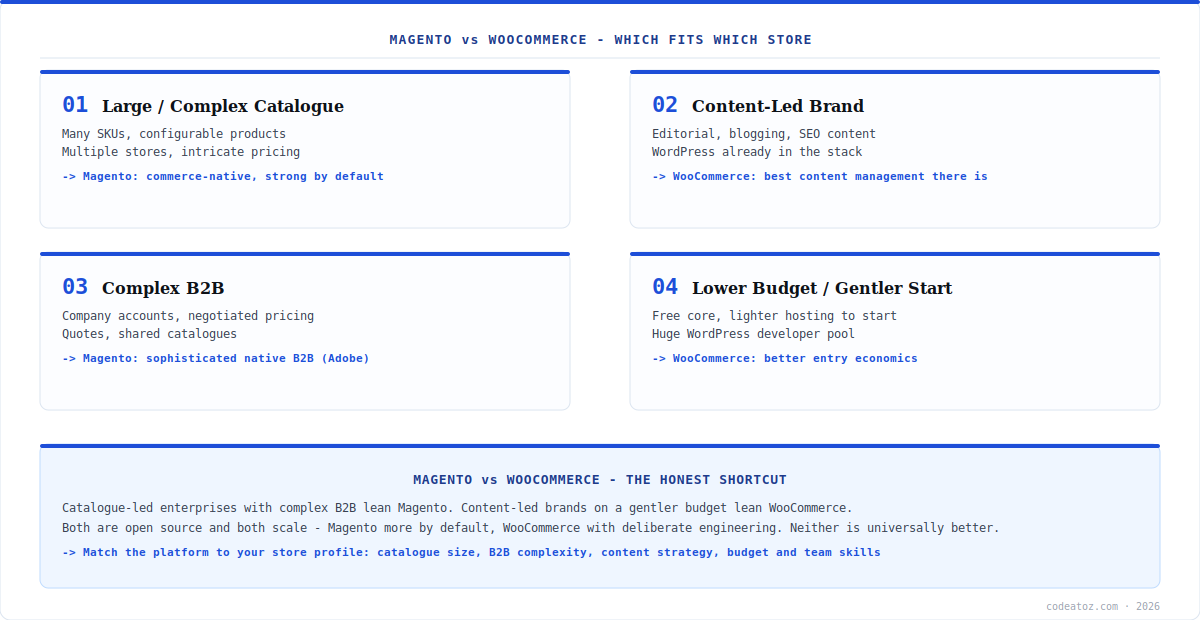
Magento vs WooCommerce: The Real Difference
The heart of the Magento vs WooCommerce distinction is what each fundamentally is. Magento is purpose-built ecommerce software — its architecture, from the catalogue model to multi-store handling to native B2B, was designed for commerce first. WooCommerce is a plugin that adds ecommerce to WordPress, the world’s most popular content management system. Neither approach is wrong, but they produce different strengths.
Because Magento is commerce-native, it handles large catalogues, complex product types, multiple stores and sophisticated pricing out of the box, at the cost of being heavier to run and steeper to learn. Because WooCommerce is WordPress-native, it inherits WordPress’s ease of use, vast plugin ecosystem and unmatched content management, at the cost of needing more assembly and effort to reach Magento’s scale ceiling. Understanding this origin difference resolves most of the Magento vs WooCommerce question before you compare a single feature.
Magento vs WooCommerce: Scale, Catalogue and Complexity
Scale is where the Magento vs WooCommerce comparison most favours Magento. For very large catalogues, high SKU counts, complex configurable products, multiple store views and intricate B2B pricing, Magento’s dedicated architecture handles the load with less custom engineering. Its native B2B — company accounts, shared catalogues, quotes — is genuinely sophisticated and covered in our B2B module guide.
WooCommerce scales further than its reputation suggests — plenty of large, high-traffic WooCommerce stores exist — but reaching that scale takes deliberate work: performance engineering, the right hosting, careful database and caching architecture, as our WooCommerce scaling guide details. The Magento vs WooCommerce reality is that Magento gives you more commerce capability by default, while WooCommerce gives you a lighter starting point you extend as you grow. For a store that is large and complex from day one, Magento’s defaults save work; for one that starts small and grows, WooCommerce’s on-ramp is gentler.
| Factor | Magento | WooCommerce |
|---|---|---|
| Origin | Dedicated commerce software | WordPress plugin |
| Large catalogues | Strong by default | Scales with engineering |
| Native B2B | Sophisticated (Adobe Commerce) | Via extensions |
| Entry cost | Higher | Lower |
| Learning curve | Steeper | Gentler (WordPress) |
| Content management | Basic | Best-in-class (WordPress) |
| Hosting needs | Heavier (search, Redis, etc.) | Lighter to start |
| Ecosystem | Commerce extensions | Vast WordPress plugin market |
Magento vs WooCommerce: Cost, Content and Ecosystem
On cost, the Magento vs WooCommerce comparison generally favours WooCommerce at the entry level. WooCommerce itself is free, runs on lighter hosting to start, and draws on a huge pool of WordPress developers, which keeps development costs down. Magento, even Open Source, needs heavier infrastructure — a search engine, Redis, ideally Varnish, as our server requirements guide sets out — and a smaller, more specialised (and often more expensive) developer pool. For a smaller store or tighter budget, WooCommerce’s economics are compelling.
Content and ecosystem are decisive WooCommerce strengths. Because it is WordPress, WooCommerce inherits the best content management in the business — for a brand whose strategy is content-led commerce (editorial, blogging, SEO content alongside products), that integration is a genuine advantage no bolt-on matches. The WordPress plugin ecosystem is also vast, so many requirements are met by an existing plugin rather than custom development. Magento’s ecosystem is smaller but commerce-focused. The Magento vs WooCommerce choice here depends on whether content is central to your strategy and how much you value plugin breadth over commerce depth.
Content-led brands lean WooCommerce; catalogue-led enterprises lean Magento. A useful shortcut in the Magento vs WooCommerce decision: if your growth engine is content and SEO with commerce attached, WooCommerce’s WordPress foundation is a real edge. If your challenge is managing a large, complex catalogue with B2B pricing at scale, Magento’s commerce-first architecture earns its extra weight.
Magento vs WooCommerce: The Verdict
The Magento vs WooCommerce verdict is refreshingly clear once you frame it by store profile rather than “which is better”. Choose WooCommerce when you want lower entry cost, a gentler learning curve, best-in-class content management, and a store that starts modest and grows — or when content-led commerce is your strategy and WordPress is already in your stack. Choose Magento when you have a large or complex catalogue, need sophisticated native B2B, require multiple stores or intricate pricing, and have (or will fund) the capability to run a heavier platform.
Many successful stores run on each, which is the point: the Magento vs WooCommerce question has no single winner, only a better fit for a given business. Be honest about your catalogue size, your B2B needs, your content strategy, your budget and your team’s skills, and the right platform usually becomes obvious. If you are on one and wondering whether to move to the other, weigh that against the real cost of replatforming — often the current platform, well built, is the better answer. Our team builds and maintains both, and will tell you plainly which fits. Our WooCommerce team does the same from the WordPress side.
How we advise on Magento vs WooCommerce
Catalogue complexity and B2B needs usually decide it. When a client has a large, complex catalogue or genuine B2B pricing requirements, Magento’s commerce-first architecture saves real engineering. When they are a growing brand with a content strategy, WooCommerce’s WordPress foundation is hard to beat. We match the platform to the store profile rather than to a house preference.
We are candid about WooCommerce at scale. WooCommerce can absolutely run large stores, but it takes deliberate performance work to get there — the “it doesn’t scale” claim is wrong, and the “it scales effortlessly” claim is equally wrong. We set the honest expectation: WooCommerce scales with engineering investment, Magento scales more by default.
Budget and team skills are not footnotes. Magento’s heavier infrastructure and smaller developer pool make it more expensive to build and run. For a client without enterprise requirements or budget, we will steer toward WooCommerce even though we do plenty of Magento work — the right platform is the one they can afford to run well.
Frequently Asked Questions About Magento vs WooCommerce
Is Magento or WooCommerce better?
Neither universally — they suit different stores. Magento is dedicated commerce software that handles large, complex catalogues and native B2B well but is heavier to run. WooCommerce is a WordPress plugin with lower entry cost, gentler learning curve and best-in-class content management. The Magento vs WooCommerce choice depends on your catalogue, budget, content strategy and team.
Can WooCommerce handle large stores like Magento?
Yes, but it takes deliberate work. Plenty of large, high-traffic WooCommerce stores exist, reached through performance engineering, appropriate hosting and careful database and caching architecture. Magento handles large catalogues and complex commerce more by default; WooCommerce scales with engineering investment. Neither the “doesn’t scale” nor “scales effortlessly” claim is accurate.
Is WooCommerce cheaper than Magento?
Generally yes at the entry level. WooCommerce is free, runs on lighter hosting to start, and draws on a large pool of WordPress developers. Magento needs heavier infrastructure — search engine, Redis, ideally Varnish — and a smaller, more specialised developer pool. For smaller stores and tighter budgets, WooCommerce’s economics are more favourable.
Which is better for B2B, Magento or WooCommerce?
Magento, generally. Adobe Commerce ships sophisticated native B2B — company accounts, shared catalogues with negotiated pricing, quotes and requisition lists. WooCommerce handles B2B through extensions, which can work well for simpler requirements but involves assembling and maintaining a stack rather than using native functionality. Complex B2B favours Magento.
Is WooCommerce better for content and SEO?
For content-led commerce, yes. Because WooCommerce is built on WordPress, it inherits the best content management available — a real advantage for brands whose strategy combines editorial, blogging and SEO content with products. Magento’s content tools are more basic. If content is central to your growth, WooCommerce’s WordPress foundation is a genuine edge.
Should I migrate from WooCommerce to Magento as I grow?
Only if you have genuinely outgrown WooCommerce — hitting real limits on catalogue complexity, B2B or scale that engineering cannot economically solve. A well-built WooCommerce store scales further than many assume, and replatforming is expensive and risky. Diagnose whether the platform is truly the constraint before migrating; often it is the build, not the platform.
Magento or WooCommerce for Your Store?
Our team builds on both and matches the platform to your catalogue, content strategy, budget and team — honestly.




