
Shopify vs WooCommerce in 2026 — An Honest Answer
Most comparisons are written by affiliates. This one is written by developers who build on both every week.
The Shopify vs WooCommerce debate never really ends — and that’s because the honest answer is “it depends.” Not in a cop-out way. In a genuinely meaningful way that hinges on a few specific factors about your business.
We build on both platforms every week. Magento too. We don’t have a preferred answer — we have clients on all three. What we do have is a clear view of which types of businesses do well on each, and where each platform starts to cause problems.
This is our actual opinion, based on real projects.
The Core Difference — What You’re Actually Choosing Between
Shopify is a hosted platform. You pay a monthly fee, Shopify manages the servers, the security patches, the infrastructure. You focus on your products. The trade-off is that you’re operating within Shopify’s rules. Some things can’t be changed. Some features require expensive higher tiers. And every sale you make, Shopify takes a transaction fee if you’re not using their payment processor.
WooCommerce is a plugin that runs on WordPress. It’s free. You pay for hosting, and you own everything — the code, the data, the database, the domain. There are no transaction fees. There are no tier restrictions. If you want to build something custom, you can. The trade-off is that you’re responsible for keeping it running, secure, and updated.
SHOPIFY — WHAT YOU GET
- Fully hosted — no server management
- Up in hours, no technical skills needed
- Built-in payment processing
- Automatic security updates
- 99.99% uptime guaranteed
- Large app ecosystem
- Good default mobile experience
WOOCOMMERCE — WHAT YOU GET
- Full source code ownership
- No transaction fees ever
- Unlimited customisation
- Complete data ownership
- WordPress content & SEO power
- B2B features without premium tiers
- No vendor lock-in
The Head-to-Head — Every Factor That Matters
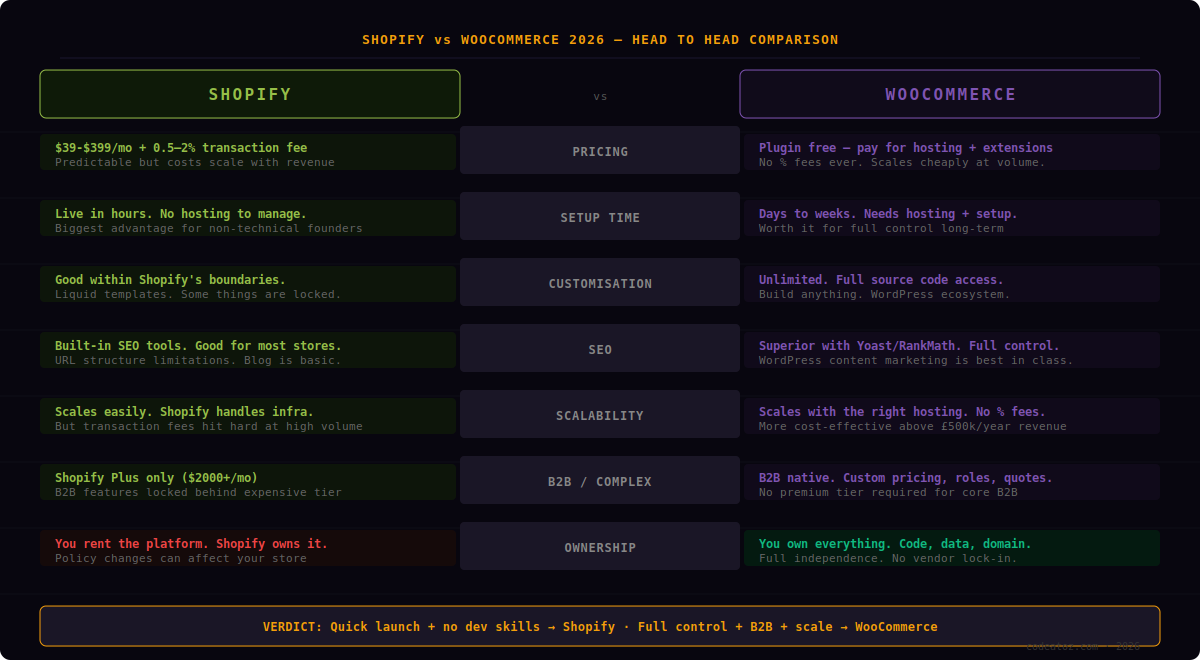
Pricing — The Number That Changes Everything
Shopify’s pricing looks simple: $39, $105, or $399 per month. But that’s not the full picture. Add transaction fees (0.5% to 2% of every sale if you use a third-party payment gateway), app costs (most serious stores spend $200–500/month on apps), and theme costs. A real Shopify operation at reasonable scale costs far more than the plan price suggests.
WooCommerce has no monthly platform fee and no transaction fees. You pay for hosting ($30–150/month depending on scale) and for any premium plugins you install. At low volume these costs are similar. At high volume, WooCommerce wins by a significant margin because there’s no percentage cut on revenue.
A store doing £500,000/year on Shopify Basic is paying roughly £5,000–10,000/year in transaction fees alone — on top of the plan cost. That same store on WooCommerce pays nothing in platform transaction fees. The hosting cost difference doesn’t come close to covering that gap.
Ease of Use — Shopify’s Biggest Advantage
This one genuinely goes to Shopify. If you’ve never built a website before, if you’re a founder who wants to focus entirely on products and marketing, if you want to be live in a day — Shopify is the right tool. It’s designed for exactly that use case and it does it well.
WooCommerce has a learning curve. You need to choose a host, install WordPress, configure it, install WooCommerce, pick a theme, and configure that. It’s not technically hard, but it’s more steps, more decisions, and more ongoing maintenance.
Shopify wins here, clearly. For non-technical founders who want to move fast, this advantage is real and significant. Don’t let anyone tell you otherwise.
SEO — WooCommerce’s Structural Advantage
Shopify has decent SEO capabilities built in. But it has structural limitations that are hard to work around: URL structures you can’t fully control, a blogging system that’s functional but not a serious content platform, and some technical SEO constraints around canonical URLs and faceted navigation.
WooCommerce runs on WordPress. WordPress has the best content management and SEO tooling in the world. Yoast SEO, RankMath, complete URL control, powerful blogging, structured data management, international SEO support — all of it is available and it’s all significantly more capable than what Shopify offers.
For stores where organic search traffic is the primary acquisition channel — which is most stores — this is a meaningful long-term advantage.
WooCommerce wins here for serious SEO strategies. If content marketing and organic search are central to your growth, WordPress/WooCommerce gives you a better platform to build on.
Customisation — Know Your Limits
Shopify’s Liquid template system is capable. For most stores, it’s more than enough. But there are things you simply cannot do on Shopify — certain checkout customisations, specific pricing logic, integrations with unusual systems. When a client hits one of those walls, the answer is either “upgrade to Shopify Plus” ($2,000+/month) or “move to WooCommerce.”
On WooCommerce, the only limit is what can be built. Because you have full access to the PHP code, the database, the WordPress hook system — anything is possible with the right developer. Custom pricing rules, complex B2B workflows, unusual integrations — none of these require a platform upgrade.
B2B — WooCommerce by a Large Margin
This is where the platforms diverge most significantly. If you sell B2B — meaning different pricing for different customers, quote requests, company accounts, approval workflows, invoice payments, net terms — Shopify doesn’t properly support this without Shopify Plus at $2,000+/month.
WooCommerce handles B2B natively. Customer role-based pricing, quote plugins, purchase order workflows, company account management — all available at far lower cost than Shopify Plus. Our own Hide Price Pro plugin handles a common B2B requirement (hiding prices from guests and showing them only to approved customers) at a fraction of what a comparable Shopify Plus setup would cost.
Ownership — A Principle Worth Thinking About
This is not just philosophical. When you run on Shopify, Shopify’s policies apply to your store. They’ve terminated accounts in the past, changed their terms, adjusted their fee structures. You are a tenant in someone else’s building.
On WooCommerce, you own the code, the database, the content, the customer data. No platform can change its policies and affect your store. No subscription cancellation can take your business offline. This independence is worth something real, particularly as your store grows and becomes more valuable.
Real Scenarios — Which Platform for Which Business
Founder with a great product, wants to launch fast
No developer. No technical experience. Wants to test a product idea and start selling within the week.
Growing D2C brand, £200k/year, content-focused
Established store with a blog, email list, organic search traffic. Wants to scale content marketing.
B2B wholesale business, custom pricing per account
Different price tiers for different customers. Quote requests. Purchase orders. Net 30 payments.
High-volume fashion brand, £1M+/year, simple catalogue
Simple product structure, lots of traffic, wants reliable infrastructure without technical overhead.
Agency managing 20+ client stores
Wants to build efficiently, maintain cleanly, and have full control over every customisation.
The Decision Framework
If you answer yes to any of the following, WooCommerce is almost certainly the better choice:
- You sell B2B or need custom pricing logic
- Content marketing and SEO are central to your growth strategy
- You need integrations with custom or unusual third-party systems
- Your revenue is above £300k/year and transaction fees are noticeable
- You need checkout customisations beyond what Shopify’s standard plans allow
- You want to own your platform and data completely
If you answer yes to any of the following, Shopify is likely the better starting point:
- You’re launching for the first time and want to move fast
- You have no developer and no plans to hire one
- Your product catalogue is straightforward — standard products, standard checkout
- You want infrastructure managed for you entirely
The most common mistake we see is founders choosing Shopify because it’s easier to start on, then hitting hard limitations at £200–500k/year that force a costly migration. If you can see yourself needing custom functionality in the next 2 years, WooCommerce from the start saves you that migration.
Can You Switch Later?
Yes — but migrations are not trivial. Moving from Shopify to WooCommerce means migrating products, customers, orders, URLs (SEO risk), and rebuilding any customisations. Done properly it takes weeks and costs real money.
The cleaner approach is to make the right call upfront. If you’re genuinely unsure, think about where your business will be in two years — not just where it is today.
Not Sure Which Platform Is Right for You?
Book a free 30-minute call. We’ll look at your specific situation — what you’re selling, how you’re growing, what you need — and give you a straight answer. No sales pitch.




