
Saleor vs Medusa — Open-source Headless Compared 2026
Saleor vs Medusa compares two leading open-source headless platforms — GraphQL-native Python against modular Node.js TypeScript — to help you pick by team and stack.
Saleor vs Medusa is the open-source headless commerce choice for teams that want to own their stack. Saleor is a GraphQL-native platform built on Python and Django; Medusa is a modular, REST-first platform built on Node.js and TypeScript. Both are MIT-licensed and self-hosted (the Saleor source and Medusa repo are public), so Saleor vs Medusa comes down to language fluency, API philosophy and how you want to extend — not licence cost.
Search intent: commercial comparison — developers choosing an open-source commerce backend. We compare Saleor vs Medusa on core stack, API style, extensibility and ecosystem, then give a decision matrix. For the SaaS comparison of one of these, see Medusa vs Shopify; for the deep Medusa walkthrough, Medusa JS.
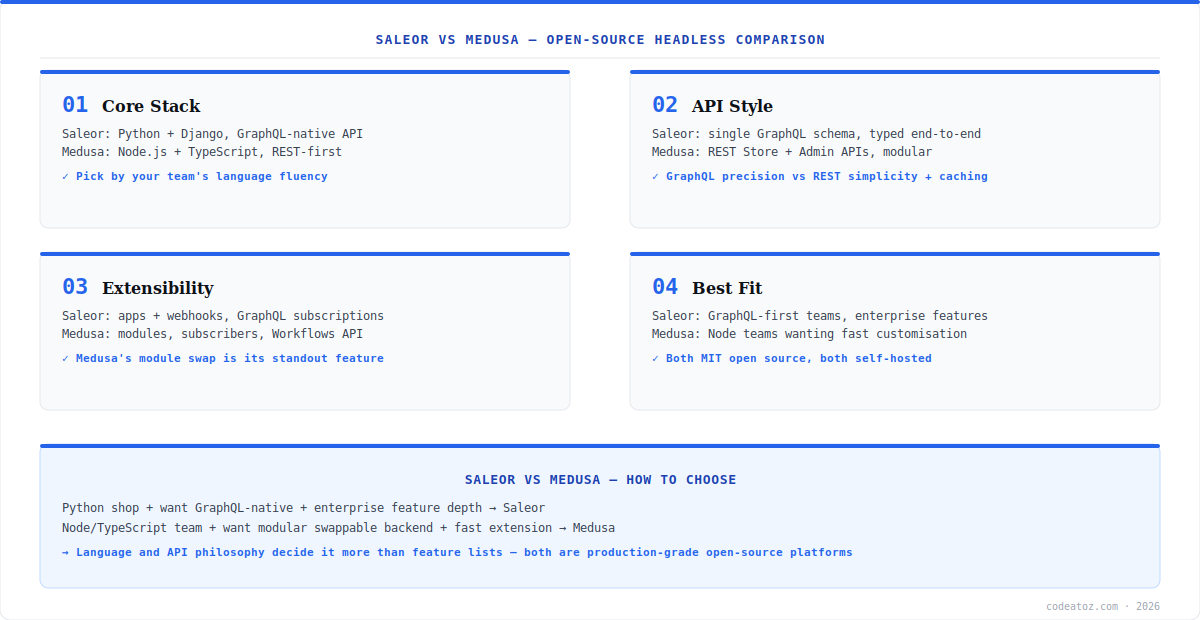
Saleor vs Medusa: Core Stack and API Style
The defining split in Saleor vs Medusa is language and API. Saleor runs on Python/Django and exposes a single, GraphQL-native API — typed end-to-end, with one schema covering storefront and admin. Medusa runs on Node.js/TypeScript and is REST-first, with separate Store and Admin APIs and a modular core. If your team lives in Python, Saleor feels native; if in JavaScript/TypeScript, Medusa does. The API choice in Saleor vs Medusa echoes the broader GraphQL vs REST trade-off: Saleor’s GraphQL gives precise fetching, Medusa’s REST gives simplicity and easy caching.
Saleor vs Medusa: Extensibility and Ecosystem
On extensibility, Saleor vs Medusa reveals different philosophies. Saleor extends through apps and webhooks, with GraphQL subscriptions for events, favouring a service-oriented extension model. Medusa’s standout is its module system — swap the pricing, inventory or fulfilment module for your own implementation — plus subscribers and the Workflows API for multi-step logic. Medusa’s modular swap-ability is frequently the deciding factor in Saleor vs Medusa for teams with unusual commerce logic. On ecosystem, both are younger than the SaaS incumbents; Saleor has strong enterprise positioning, Medusa a fast-growing Node community. The Saleor documentation and Medusa documentation show each model.
| Factor | Saleor | Medusa |
|---|---|---|
| Language | Python / Django | Node.js / TypeScript |
| API style | GraphQL-native (one schema) | REST-first (Store + Admin) |
| Extensibility | Apps, webhooks, subscriptions | Modules, subscribers, Workflows |
| Standout | GraphQL end-to-end typing | Swappable modules |
| Best fit | Python + GraphQL teams | Node/TS teams, custom logic |
Saleor vs Medusa: The Verdict
The Saleor vs Medusa verdict is refreshingly clear because it tracks your team. Choose Saleor if you are a Python shop, want a GraphQL-native API with end-to-end typing, and value its enterprise-oriented feature depth. Choose Medusa if you are a Node/TypeScript team, want a modular backend you can extend and swap quickly, and prefer REST simplicity with the Workflows API for complex logic. Both are production-grade, MIT-licensed and self-hosted, so the Saleor vs Medusa decision rests on language and API philosophy far more than on a feature checklist. Our commerce engineering team builds and operates both.
How we decide Saleor vs Medusa for clients
Language fluency is the first filter, and usually the last. A Python team will be far more productive maintaining Saleor; a Node/TypeScript team, Medusa. We rarely override this — owning an open-source platform means living in its codebase, so the team’s primary language matters more than any feature comparison.
Medusa’s module system wins for bespoke logic. When a client needs to replace pricing or fulfilment with something custom, Medusa’s swappable modules make that clean. Saleor’s app/webhook model is excellent for integrations but less suited to deep core replacement.
Both need the same operational respect as any self-hosted platform. Postgres, Redis, monitoring, upgrades — Saleor vs Medusa does not change the fact that you are running infrastructure. We budget operations identically for both and pick on developer fit.
Frequently Asked Questions About Saleor vs Medusa
What is the difference between Saleor and Medusa?
Saleor is a GraphQL-native headless commerce platform built on Python and Django; Medusa is a modular, REST-first platform built on Node.js and TypeScript. Both are MIT-licensed open-source and self-hosted. Saleor vs Medusa comes down to language, API style and extensibility model rather than licensing.
Is Saleor or Medusa better for a Node.js team?
Medusa, clearly. It is built in Node.js and TypeScript, so a JavaScript team can read, extend and maintain it natively. Saleor’s Python/Django core would force a Node team to work in an unfamiliar language. In Saleor vs Medusa, language fluency is usually the deciding factor.
Which has better extensibility, Saleor or Medusa?
They extend differently. Saleor uses apps, webhooks and GraphQL subscriptions, strong for integrations. Medusa uses swappable modules, subscribers and a Workflows API, strong for replacing core logic. For deep customisation of pricing or fulfilment, Medusa’s module system often wins the Saleor vs Medusa extensibility comparison.
Are Saleor and Medusa both free?
Both are free and open source under the MIT license, and both are self-hosted with no platform or transaction fees. Your costs in Saleor vs Medusa are hosting (PostgreSQL, Redis, servers) and the engineering time to build, extend and operate them — identical operational considerations for both.
Does Saleor use GraphQL and Medusa use REST?
Yes. Saleor is GraphQL-native with a single typed schema for storefront and admin. Medusa is REST-first with separate Store and Admin APIs. This API difference in Saleor vs Medusa mirrors the GraphQL versus REST trade-off — GraphQL precision and typing versus REST simplicity and easy caching.
Which should I choose, Saleor or Medusa?
Choose Saleor for a Python team wanting GraphQL-native APIs and enterprise feature depth. Choose Medusa for a Node/TypeScript team wanting a modular, swappable backend with the Workflows API for custom logic. The Saleor vs Medusa decision rests primarily on your team’s language and your API philosophy.
Choosing an Open-Source Headless Platform?
Our team builds on both Saleor and Medusa — and picks the right one for your team’s stack and logic.




