
The Complete Medusa JS Guide — Open-source Node Commerce 2026
Build on Medusa JS — the open-source Node.js commerce platform with swappable modules, a React admin, the Next.js starter storefront, and TypeScript workflows.
Medusa JS is the leading open-source commerce platform for Node.js teams — a TypeScript core with swappable commerce modules (cart, pricing, inventory, fulfilment, payments), auto-generated REST APIs, a React admin dashboard, and an official Next.js storefront starter. With Medusa JS you own the entire stack: host anywhere, pay no per-transaction platform fees, and write custom commerce logic in the same language as your frontend.
Where Shopify gives you a managed platform with extension points, Medusa JS gives you the platform itself. The core runs on PostgreSQL and Redis — standard infrastructure — and every commerce concern is a module you can configure, extend or completely replace: swap the pricing module for your ERP-driven logic, replace inventory with a 3PL-backed implementation, keep the rest stock. This guide covers the architecture, the development workflow, the storefront layer, and the honest decision criteria versus SaaS platforms. The Medusa documentation is the canonical reference.
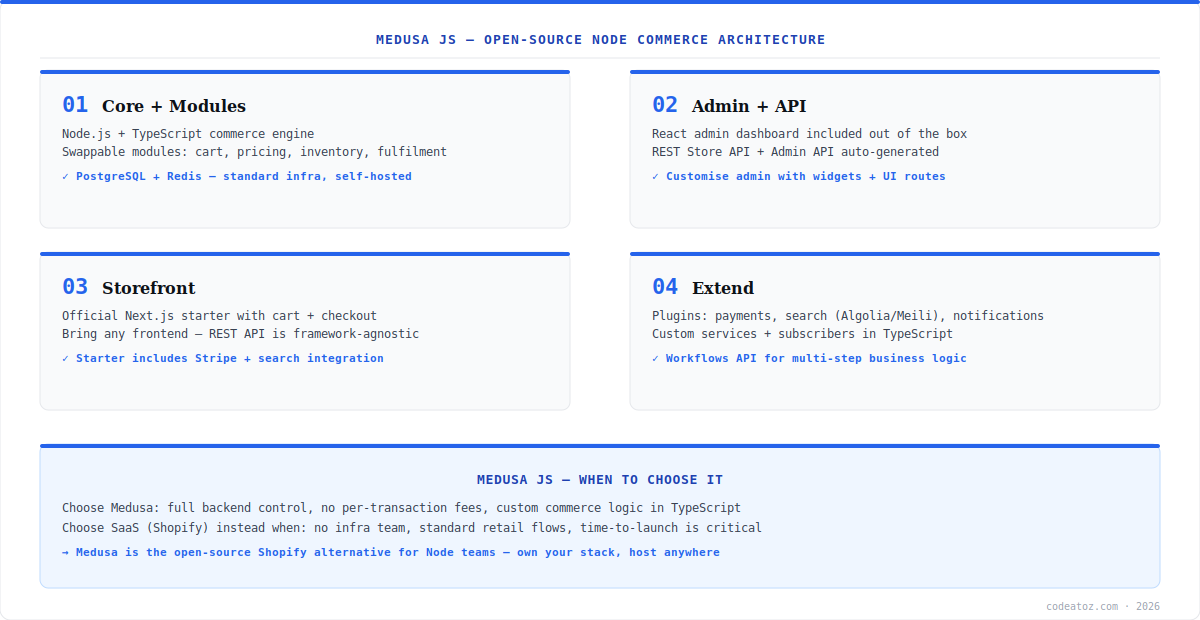
Medusa JS: Architecture and Modules
The Medusa JS core is a Node.js application exposing two auto-generated REST APIs — the Store API for storefronts and the Admin API for back-office — over a set of commerce modules: products, carts, orders, pricing, promotions, inventory, fulfilment, payments, customers, and regions. Modules are isolated with explicit interfaces, which is what makes them swappable: implement the module interface and Medusa wires your version in place of the default. Setup is one command and the standard infra pair:
npx create-medusa-app@latest my-store
# Prompts: project name, PostgreSQL connection, admin user
# Optionally scaffolds the Next.js storefront alongside

cd my-store
npm run dev
# Admin dashboard: http://localhost:9000/app
# Store API:       http://localhost:9000/store
# Admin API:       http://localhost:9000/admin
Medusa JS: Storefront, Customisation and Workflows
The official Medusa JS Next.js starter ships a complete storefront — product pages, cart, checkout with Stripe, customer accounts — built on the Store API, and because the API is plain REST, any frontend from this series works: Astro, Remix patterns, Nuxt. Customisation happens in TypeScript: custom services and API routes for new capabilities, subscribers reacting to events (order.placed → ERP push), and the Workflows API for multi-step business logic with rollback semantics — the Medusa JS answer to “what happens when step three of five fails”. Plugins cover payments (Stripe, PayPal, Adyen), search (Algolia, Meilisearch) and notifications — browse the catalogue in the Medusa plugin directory. The Workflows documentation covers the orchestration model — it is the feature that separates Medusa from “Express with a product table”.
Choose Medusa JS when you have a Node/TypeScript team, commerce logic that fights SaaS constraints (complex B2B pricing, unusual fulfilment, marketplace mechanics), and the appetite to own hosting and upgrades. Choose Shopify when time-to-launch dominates, flows are standard retail, and there is no infra team — a platform you operate is a responsibility, not just a licence saving.
Medusa JS: Deployment and Production Notes
Production Medusa JS needs three pieces: the server (Railway, Render, Fly.io, or any Node host), PostgreSQL (managed — Neon, Supabase, RDS), and Redis for the event bus and caching. Run the worker mode separately from the API server at scale so background jobs (notification sending, workflow steps) never compete with request latency. Front it with the same edge patterns as any headless build — cache product reads at the CDN, never cache carts — and the result competes with any SaaS on performance while keeping per-order economics flat. Our headless commerce team builds and operates Medusa JS stacks for teams that want commerce as code; see the headless architecture guide for where Medusa fits the broader decision tree.
Frequently Asked Questions About Medusa JS
What is Medusa JS?
Medusa JS is an open-source (MIT) commerce platform built in Node.js and TypeScript — swappable commerce modules, auto-generated Store and Admin REST APIs, a React admin dashboard, and an official Next.js storefront starter. It runs on PostgreSQL and Redis, hosts anywhere, and charges no platform or per-transaction fees.
Is Medusa JS a good Shopify alternative?
For Node/TypeScript teams needing custom commerce logic — complex B2B pricing, unusual fulfilment, marketplace mechanics — yes: Medusa JS offers full backend control with no per-transaction fees. For standard retail with no infra team, Shopify’s managed platform usually wins on time-to-launch and operational burden. The trade is control versus operations.
What infrastructure does Medusa JS need?
A Node.js host (Railway, Render, Fly.io or any server), managed PostgreSQL, and Redis for the event bus and caching. At scale, run worker mode separately from the API server so background jobs never compete with request latency. Total baseline cost is typically a fraction of equivalent SaaS plans, traded against your team operating it.
What frontends work with Medusa JS?
Any. The official Next.js starter ships a complete storefront with cart, Stripe checkout and accounts, but the Store API is plain REST — Astro, Remix, Nuxt, SvelteKit or a mobile app all integrate the same way. The starter is the fastest path; framework-agnostic APIs are the long-term flexibility.
How do I customise Medusa JS?
In TypeScript: custom services and API routes add capabilities, subscribers react to events (order.placed pushing to an ERP), module implementations replace core behaviour (custom pricing, 3PL inventory), and the Workflows API orchestrates multi-step logic with rollback when intermediate steps fail. Plugins cover payments, search and notifications off the shelf.
Is Medusa JS production-ready?
Yes — Medusa JS powers production stores at significant scale, with v2’s module isolation and Workflows API designed specifically for reliability under partial failure. Production readiness depends more on your operational setup: managed PostgreSQL, separated worker processes, monitored Redis and standard Node observability are the checklist items.
Building on Medusa JS?
Our team builds and operates Medusa stacks — custom modules, workflows, storefronts and deployment.




