
GraphQL vs REST for Ecommerce — The 2026 Decision Guide
GraphQL vs REST for ecommerce is not about which is better — it is about which fits each job. A decision matrix across fetching, caching, operational cost and use case.
GraphQL vs REST for ecommerce is one of the most consequential architecture decisions a headless build makes — and the most commonly mis-framed. It is rarely a winner-take-all choice. The strongest commerce stacks use GraphQL vs REST as a per-job decision: GraphQL where frontends need precise, nested data in one trip, REST where simple, heavily-cached reads or public integrations dominate. This guide gives you the decision matrix to choose correctly per use case.
Search intent: comparison and decision — developers and architects choosing the API style for a headless commerce frontend. We evaluate GraphQL vs REST across the four axes that actually decide it in production: data fetching efficiency, caching, operational cost, and best-fit use cases. Both the GraphQL specification and standard REST conventions are mature; the question is fit, not maturity.
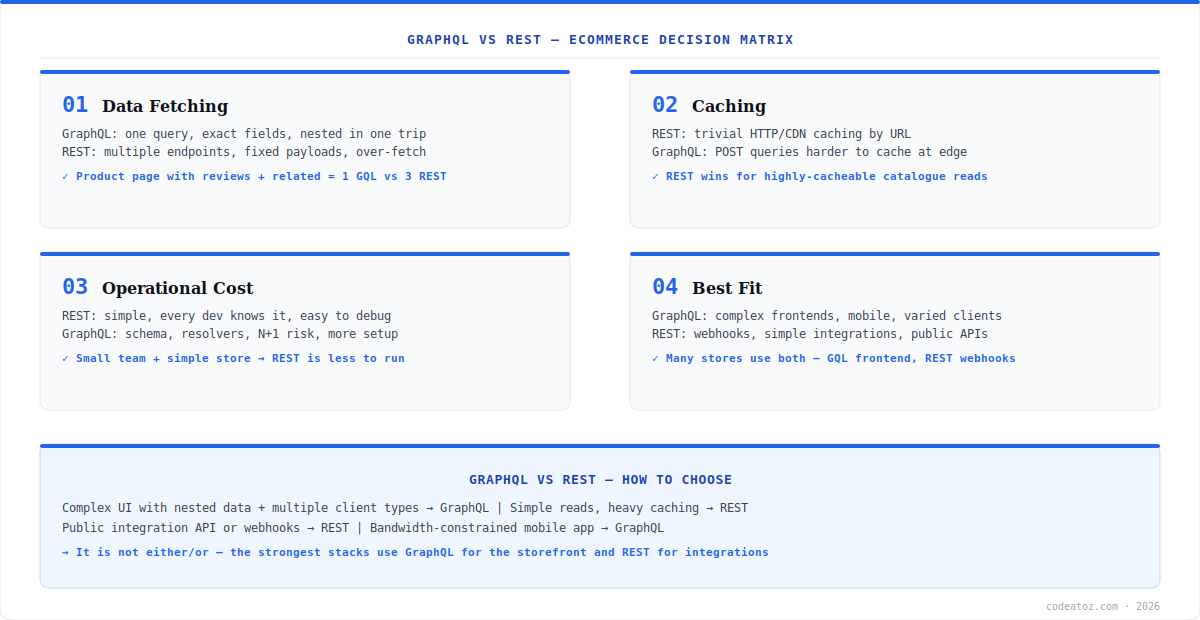
GraphQL vs REST: Data Fetching and Over-fetching
The clearest win in GraphQL vs REST is data fetching. A product page needing the product, its variations, related items and reviews makes one GraphQL query returning exactly those fields — versus three or four REST calls each returning full objects you mostly discard. For complex, data-rich frontends and bandwidth-constrained mobile clients, this round-trip and payload reduction is decisive. REST counters with simplicity (the WordPress REST API handbook is a good reference): every developer understands it, every tool debugs it, and there is no resolver layer to operate. Where the UI is simple and reads are uniform, REST’s over-fetching costs little.
GraphQL vs REST: Caching and Operational Cost
This is where the GraphQL vs REST comparison flips. REST GET requests cache trivially at the CDN by URL — a product endpoint is a cache key, and edge caching is nearly free. GraphQL’s POST queries do not cache by URL, requiring persisted queries (hashing queries into cacheable GET requests) to reach the same edge performance. Operationally, REST is lighter: no schema to maintain, no resolver N+1 problems, no query-complexity attacks to defend against. GraphQL’s power comes with a standing operational cost — schema governance, depth/complexity limits, and dataloader batching to avoid database storms. For a small team on a simple catalogue, that overhead is real and worth weighing against the fetching gains. These caching realities feed directly into your CDN architecture and rendering-strategy choices.
| Factor | GraphQL | REST |
|---|---|---|
| Fetching | One query, exact fields, nested | Multiple endpoints, fixed payloads |
| Over-fetching | Eliminated | Common |
| Edge caching | Needs persisted queries | Trivial by URL |
| Operational cost | Higher (schema, resolvers, N+1) | Lower (familiar, simple) |
| Best fit | Complex UIs, mobile, varied clients | Webhooks, integrations, simple reads |
GraphQL vs REST: The Hybrid Answer Most Stores Land On
In practice the GraphQL vs REST question resolves to “both, for different layers”. A common, well-architected pattern: GraphQL for the storefront (precise data for complex product and category pages, served via WPGraphQL on WooCommerce or the Storefront API on Shopify), and REST for webhooks, third-party integrations and simple server-to-server reads. This plays to each style’s strength and avoids forcing one paradigm onto jobs it fits poorly. The decision rule: choose GraphQL vs REST per interface, driven by data shape and caching needs, not by ideology. The Apollo GraphQL documentation covers the persisted-query and caching patterns that make GraphQL production-ready, and our headless commerce team designs the split per project.
How we actually choose between GraphQL and REST
We default the storefront to GraphQL, the integrations to REST. On headless WooCommerce and Shopify builds, the storefront benefits enormously from GraphQL’s precise fetching — but we almost always keep REST for webhook receivers and ERP/CRM sync, because those are simple, cacheable, and every integration partner already speaks REST.
The biggest GraphQL mistake we fix is missing complexity limits. Teams ship a flexible schema, then a single deeply-nested query (or a malicious one) takes down the database. Depth limits, complexity scoring and dataloader batching are non-negotiable before launch.
If a team has no GraphQL experience and the store is simple, we recommend REST. The fetching gains do not justify the operational learning curve for a small catalogue with a straightforward frontend. Match the tool to the team, not just the problem.
Frequently Asked Questions About GraphQL vs REST for Ecommerce
Is GraphQL or REST better for ecommerce?
Neither is universally better — GraphQL vs REST is a per-use-case decision. GraphQL excels for complex storefronts needing precise, nested data in one request. REST excels for cacheable reads, webhooks and simple integrations. Most production stacks use GraphQL for the storefront and REST for integrations and webhooks.
Why is REST easier to cache than GraphQL?
REST GET requests have unique URLs that act as cache keys, so CDNs cache them trivially. GraphQL sends queries as POST requests with no cacheable URL. To reach the same edge caching in the GraphQL vs REST comparison, GraphQL needs persisted queries that hash each query into a cacheable GET request.
Does GraphQL reduce over-fetching in ecommerce?
Yes — this is GraphQL’s signature advantage in the GraphQL vs REST debate. A GraphQL query returns exactly the fields requested, so a product page fetches product, variations, related items and reviews in one trip with no wasted data. REST endpoints return full fixed objects, sending fields the client discards.
What is the operational cost difference between GraphQL and REST?
GraphQL carries higher operational cost: schema governance, resolver maintenance, N+1 query prevention with dataloaders, and query-complexity limits to prevent abuse. REST is operationally simpler — familiar to every developer, easy to debug, no resolver layer. For small teams and simple stores, this difference often tips the GraphQL vs REST decision toward REST.
Can I use both GraphQL and REST in one ecommerce stack?
Yes, and most well-architected stores do. The common pattern uses GraphQL for the storefront frontend (precise data for complex pages) and REST for webhooks, third-party integrations and simple server-to-server reads. GraphQL vs REST is rarely either/or — using both plays to each style’s strengths.
When should I choose REST over GraphQL for a store?
Choose REST when the frontend is simple with uniform reads, when your team has no GraphQL experience, when heavy CDN caching is the priority, or when building public APIs and webhook integrations. In these cases the GraphQL vs REST trade favours REST’s simplicity and caching over GraphQL’s fetching precision.
Designing Your Ecommerce API Layer?
Our team architects the GraphQL and REST split for headless stores — storefront precision plus cacheable integrations.




