
Replatforming Cost — What an Ecommerce Migration Really Costs in 2026
Replatforming cost is far more than the platform’s price tag. The licence is the small part — design, data, integrations and SEO are where the budget actually goes. Here is the full picture.
Replatforming cost is where ecommerce migration budgets go wrong, because merchants anchor on the number they can see — the new platform’s monthly fee or licence — and that is the smallest part of the real total. The true replatforming cost is dominated by design and build, data migration, integration rebuilding, and a set of hidden costs (SEO, training, downtime risk) that sink underestimated budgets. This guide lays out the whole picture, so you can budget a migration honestly rather than discovering the real cost halfway through.
Search intent: informational/budgeting — merchants and decision-makers planning a migration budget. We cover why the sticker price misleads, the design and build cost, data and integration rebuilding, the hidden costs, and how to budget properly. It builds on our migration decision framework and Magento vs Shopify Plus guide.
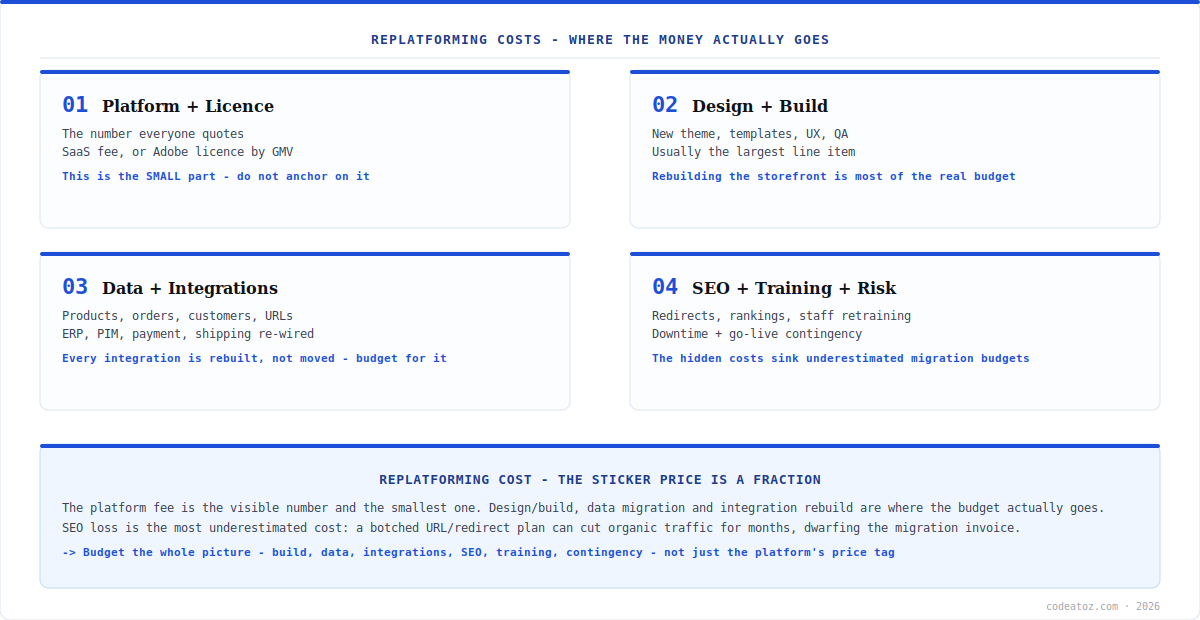
Replatforming Cost: The Sticker Price Is a Fraction
The visible replatforming cost — a SaaS platform’s monthly fee, or an Adobe Commerce licence scaled by revenue — is what gets quoted in the sales conversation, and it anchors expectations far too low. That fee is real, but it is a fraction of the total cost of moving to a new platform. Budgeting a migration on the platform price alone is like budgeting a house move on the cost of the new address’s council tax: it is a genuine ongoing cost, but it tells you almost nothing about what the move itself costs.
The actual replatforming cost is a project cost: the labour and services required to rebuild your store on the new platform, move your data, re-wire your integrations, preserve your SEO and get your team operating on it. Those are the numbers that determine whether a migration is affordable, and they are absent from the platform’s pricing page. The rest of this guide walks each one.
Replatforming Cost: Design and Build Is the Biggest Line
The largest single component of replatforming cost is almost always design and build — recreating your storefront on the new platform. Your existing theme does not transfer; a new platform means a new front end, which means design, templating, responsive work, quality assurance and the building of every custom feature your store relies on. If you are also taking the opportunity to redesign (many merchants do), that adds design cost on top.
This is why replatforming cost scales with store complexity rather than platform price. A simple catalogue with standard functionality is a contained build; a store with custom checkout logic, bespoke product configurators, complex category structures and unusual workflows requires all of that to be rebuilt on the new platform, sometimes from scratch because the new platform works differently. Scoping this honestly — every custom feature, every template, every integration touchpoint — is the single most important step in estimating replatforming cost accurately, and the one most often rushed.
Replatforming Cost: Data and Integrations Are Rebuilt, Not Moved
Two components of replatforming cost are consistently underestimated because they sound simple and are not. Data migration — moving products, categories, customers, order history and URL structures to the new platform — is rarely a clean export-import. Data models differ between platforms, so data must be transformed, cleaned and validated, and mistakes here corrupt catalogues or lose order history. On a large store with years of data, this is a substantial line item.
Integrations are the bigger surprise. Every system connected to your store — ERP, PIM, payment gateways, shipping, tax, email marketing, analytics — is integrated with your current platform, and none of those integrations transfer. Each must be rebuilt against the new platform’s APIs. A store with a dozen integrations is a dozen rebuild projects, and this is frequently the component that blows a replatforming cost estimate, because merchants think of integrations as things they “have” rather than things that must be re-created. Inventory every connected system before budgeting.
| Cost component | Visibility | Typical size |
|---|---|---|
| Platform licence / fee | Highly visible | Small (but ongoing) |
| Design + build | Anticipated | Largest single line |
| Data migration | Underestimated | Scales with data volume |
| Integration rebuild | Often forgotten | Scales with integrations |
| SEO preservation | Hidden | Critical, easily skimped |
| Training + change | Hidden | Real but modest |
| Downtime + contingency | Hidden | Risk-dependent |
Replatforming Cost: The Hidden Costs and How to Budget
The hidden components of replatforming cost are where budgets quietly fail. SEO preservation is the most important: a migration changes URLs and page structures, and without a rigorous redirect and URL-mapping plan, organic traffic can drop for months. The cost of that lost traffic can exceed the entire migration budget, which makes SEO work not an optional extra but core scope. Training and change management — getting your team productive on a different platform — is a real if modest cost. And downtime risk plus contingency (things go wrong at go-live) belongs in any honest replatforming cost budget.
To budget properly, cost every component, not just the visible one: platform fee, design and build (scoped feature by feature), data migration (sized to your data volume), integration rebuild (one line per connected system), SEO preservation, training, and a contingency for the risk. The discipline is to treat replatforming cost as the full project cost it is, and then compare that honest total against the cost of fixing your current platform — the comparison at the heart of our migration decision framework. A migration budgeted on the sticker price alone will overrun; one budgeted on the whole picture can be planned with confidence. Our team scopes full migration costs before a client commits, precisely so there are no halfway-through surprises.
The estimate that only counts the platform fee is not an estimate. The most common cause of a migration going over budget is anchoring on the visible replatforming cost and discovering design, data, integrations and SEO later. Scope all of it up front. A migration is a major project; budget it like one, with every component costed and a contingency for the risk.
How we scope replatforming cost
Integrations are where estimates blow up, so we inventory them first. Merchants think of ERP, PIM, payment and shipping connections as things they have, not things that must be rebuilt against a new platform’s APIs. We list every connected system at the start, because each is effectively its own small project and collectively they often rival the build cost.
We scope the build feature by feature, not as a lump. “Rebuild the store” hides enormous variation. A store with custom checkout logic and bespoke configurators costs far more than a standard catalogue. We walk every custom feature and template, because that granular scope is the difference between an accurate estimate and an expensive surprise.
SEO is core scope, never an add-on. We build the redirect and URL-mapping plan into the migration cost from the start, because the alternative — a rankings drop discovered after go-live — can cost more than everything else combined. Clients sometimes want to trim it to save budget; we explain why that is the worst place to economise.
Frequently Asked Questions About Replatforming Cost
What does replatforming actually cost?
Far more than the platform fee. The real replatforming cost is dominated by design and build (usually the largest line), data migration, integration rebuilding, and hidden costs like SEO preservation, training and contingency. The platform licence is the smallest, most visible part. Total cost scales with store complexity and number of integrations, not with the platform’s price.
Why is the platform fee such a small part of the cost?
Because migration is a project, not a subscription. The fee is an ongoing cost of running the new platform, but the migration itself is the labour to rebuild your store, move and transform your data, re-wire every integration and preserve your SEO. Those project costs dwarf the platform fee, which is why budgeting on the sticker price misleads badly.
Why do integrations cost so much in a migration?
Because they are rebuilt, not moved. Every system connected to your store — ERP, PIM, payment, shipping, tax, marketing — is integrated with your current platform, and none of those transfer. Each must be re-created against the new platform’s APIs. A store with a dozen integrations is a dozen rebuild projects, and this is frequently what blows a migration budget.
Is SEO really a replatforming cost?
Yes, and one of the most important. A migration changes URLs and page structures, so without a rigorous redirect and URL-mapping plan, organic traffic can drop for months. The value of that lost traffic can exceed the entire migration budget, which makes SEO preservation core scope rather than an optional extra to trim for savings.
How do I budget a replatforming project accurately?
Cost every component, not just the visible fee: platform cost, design and build scoped feature by feature, data migration sized to your data, integration rebuild as one line per connected system, SEO preservation, training and a contingency for risk. Then compare that honest total against the cost of fixing your current platform before deciding.
What makes replatforming cost vary so much between stores?
Store complexity and integration count. A simple catalogue with standard functionality is a contained build; a store with custom checkout logic, bespoke configurators, complex catalogue structures and many integrations requires all of that rebuilt on the new platform. The platform is nearly constant; your store’s complexity is what drives the replatforming cost up or down.
Budgeting a Migration Properly?
Our team scopes full replatforming cost — build, data, integrations, SEO — before you commit, so there are no surprises.




