
What Is the Real Magento Development Cost in 2026?
Magento development cost is not a single number — it is a range driven by how custom your build is and how many systems it integrates with. Here is the honest breakdown of where the budget actually goes.
Magento development cost is one of the most-searched and worst-answered questions in ecommerce, because the honest answer — “it depends” — is unsatisfying, and the dishonest answer — a single confident number — is worthless. The truth is that Magento development cost spans a wide range, and where your project lands depends on a handful of specific factors: how much custom functionality you need, how many systems you integrate with, and whether you count the ongoing running cost or just the build. This guide breaks down each so you can budget realistically.
Search intent: informational/budgeting — merchants and decision-makers planning a Magento build or budget. We cover why there is no single price, the components of build cost, ongoing running cost, what moves the number most, and how to budget. It builds on our Magento server requirements guide and Magento vs Shopify Plus guide.
Magento Development Cost: Why There Is No Single Price
Anyone who quotes a firm Magento development cost without understanding your requirements is guessing. The range is enormous because Magento can be almost anything: a straightforward catalogue store on a ready theme sits at one end, and a heavily customised enterprise platform with complex B2B, bespoke checkout logic and a dozen integrations sits at the other, many times more expensive. Both are “a Magento store”, and their costs share little.
This is why the useful question is not “what does Magento cost” but “what does my Magento project cost”, which can only be answered by scoping the actual work. The factors that determine Magento development cost are the same ones that determine the effort: the amount of custom development, the number and complexity of integrations, the design ambition, and whether you are building fresh or migrating. Understand those, and the range narrows from “anything” to a defensible estimate.
Magento Development Cost: The Build Components
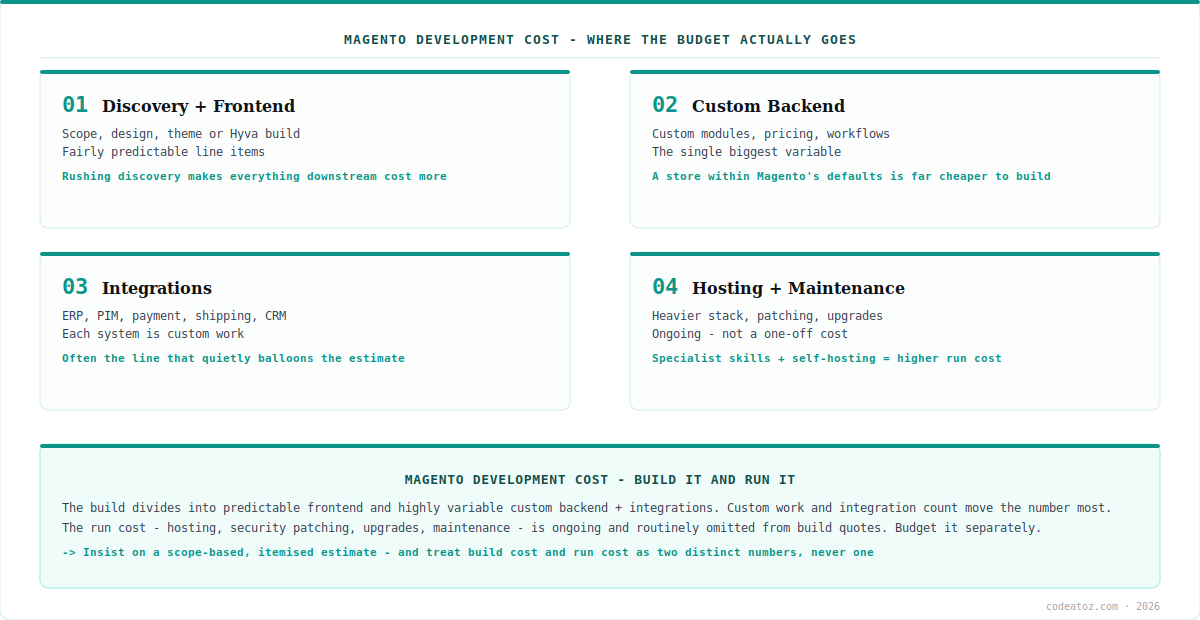
The build side of Magento development cost divides into predictable components. Discovery and design come first — defining requirements, information architecture and the storefront design — and rushing this reliably makes everything downstream more expensive. Then the front-end build: your theme, whether a Hyvä theme or a bespoke storefront, along with templates and responsive work. This is substantial but relatively predictable.
The component that most moves Magento development cost is backend and custom module development. Standard Magento functionality is included; every deviation from it — custom pricing rules, bespoke product types, unusual workflows, custom admin tools — is development effort. A store that lives within Magento’s defaults is far cheaper to build than one that bends the platform to unusual requirements. Integrations are the other big variable, covered below. Scoping these feature by feature, rather than as a lump, is what separates an accurate Magento development cost estimate from a number that overruns.
| Build component | Predictability | Cost driver |
|---|---|---|
| Discovery + design | Moderate | Design ambition, complexity |
| Theme + frontend | Fairly predictable | Bespoke vs ready theme |
| Backend + custom modules | Highly variable | Amount of custom logic |
| Integrations | Variable | Number of systems |
| Data migration | Variable | Volume + source platform |
| QA + launch | Moderate | Overall complexity |
Magento Development Cost: The Ongoing Run Cost
The most commonly overlooked part of Magento development cost is that it does not end at launch. Magento is a self-hosted platform, which means you carry ongoing costs the build quote often omits. Hosting is the obvious one, and Magento is not light — it wants a proper stack with a search engine, Redis and ideally Varnish, as our server requirements guide details, so hosting costs more than a simple website’s.
Beyond hosting, budget for maintenance: security patching (essential, as our security checklist explains), Magento version upgrades, bug fixes, and the inevitable iteration as your business evolves. A store is a living system, not a build-and-forget project. Factoring this ongoing Magento development cost into your budget from the start — whether via an in-house resource, a maintenance retainer or an agency relationship — is what keeps a store secure and current rather than slowly decaying into a liability. A build budget without a run budget is only half a plan.
Specialist skills make Magento pricier per hour than general web work. Part of Magento development cost is simply that good Magento developers are a smaller, more specialised pool than general WordPress or front-end developers, and specialist skills command higher rates. That is not a markup to resent; it reflects the genuine depth Magento demands. It does mean, though, that Magento is rarely the cheapest platform to build or run — a factor worth weighing against its capability.
Magento Development Cost: How to Budget Honestly
To budget Magento development cost realistically, insist on a scope-based estimate rather than a headline figure. A good quote itemises: discovery and design, front-end build, each custom feature, each integration, data migration if applicable, QA and launch, and — separately — the ongoing hosting and maintenance. If a quote is a single number with no scope behind it, it is a guess, and guesses overrun.
Then be honest with yourself about scope. The biggest driver of Magento development cost overruns is scope creep — features added mid-build that were not in the original estimate. Deciding up front what is truly needed for launch versus what can come later (a phased approach, as our project scoping guide covers) keeps the initial cost contained and the estimate accurate. Magento is a powerful, capable platform, and it is worth its cost for the right store — but only if you budget the whole picture, build and run, against an honestly scoped set of requirements. Our Magento team scopes and estimates builds this way, itemised and honest, so there are no surprises.
How we estimate Magento development cost
We refuse to quote a number without scope. When someone asks “what does a Magento store cost” we ask questions back, because a figure given blind is worse than useless — it anchors expectations wrongly in one direction or the other. An honest estimate follows from understanding the actual requirements, not from a price list.
Custom development and integrations are where we focus the scoping. The theme build is fairly predictable; the budget moves on how much the store deviates from standard Magento and how many systems it connects to. We scope those two areas hardest, because that is where an estimate is accurate or wildly off.
We always separate build cost from run cost. Clients frequently budget the build and forget hosting, patching and maintenance. We present them as two distinct numbers, because a store that is launched and then never maintained becomes a security and performance liability — the run cost is not optional, and pretending otherwise helps no one.
Frequently Asked Questions About Magento Development Cost
How much does Magento development cost?
There is no single figure — Magento development cost spans a wide range depending on how custom the build is, how many integrations it needs, the design ambition and whether you are building fresh or migrating. A simple catalogue store on a ready theme costs a fraction of a heavily customised enterprise platform. Only a scoped estimate gives a real number.
What makes Magento more expensive than other platforms?
Two things: it is a self-hosted platform needing a heavier stack (search engine, Redis, ideally Varnish) so hosting costs more, and good Magento developers are a smaller, more specialised pool commanding higher rates. That reflects genuine depth rather than a markup, but it does mean Magento is rarely the cheapest platform to build or run.
What drives Magento development cost up the most?
Custom development and integrations. Standard Magento functionality is included; every deviation — custom pricing, bespoke product types, unusual workflows — is effort. And each connected system (ERP, PIM, payment, shipping) is custom integration work. A store living within Magento’s defaults with few integrations is far cheaper than one bending the platform with many.
Does Magento development cost include ongoing fees?
It should, but build quotes often omit them. As a self-hosted platform Magento carries ongoing hosting (heavier than a simple site), plus maintenance: security patching, version upgrades, bug fixes and iteration. Budget build cost and run cost as two separate numbers — a store without a maintenance budget decays into a security and performance liability.
How do I get an accurate Magento cost estimate?
Insist on a scope-based, itemised quote: discovery and design, front-end build, each custom feature, each integration, data migration if any, QA and launch, plus separate ongoing hosting and maintenance. A single number with no scope behind it is a guess. Then control scope creep, the biggest cause of overruns, by deciding what is truly needed for launch.
Is Magento worth the cost versus a cheaper platform?
For the right store, yes — Magento’s depth in large catalogues, complex B2B and deep customisation justifies its cost when you genuinely need those capabilities. For a simpler store without enterprise requirements, a lighter platform like WooCommerce or a SaaS option may deliver what you need for less. Match the platform’s cost to your actual requirements.
Planning a Magento Build or Budget?
Our team scopes Magento projects and gives itemised, honest estimates — build cost and run cost, no surprises.




