
10 Critical Signs You Need an E-Commerce Developer — Not Just Another Plugin
Honest advice for store owners who are spending money on fixes that aren’t fixing anything.
If you’re debating whether to hire an e-commerce developer or install yet another plugin, this guide is for you. We’ve seen hundreds of WooCommerce, Magento, and Shopify stores hit the same walls — problems that plugins genuinely cannot fix. Here are the 10 most common signs that your store needs an e-commerce developer, not another add-on. A good e-commerce developer saves you from months of plugin-stacking that leads nowhere. Free 30-minute technical audit at the end.
There’s a pattern we see regularly. A store owner has a problem — slow site, broken checkout, plugin conflicts. They search for a solution, find a plugin, install it. Problem persists. They install another plugin. Now they have two problems.
Plugins solve problems that plugins can solve. Some problems are deeper than that. If you recognise yourself in any of the following situations, it’s worth having an honest conversation with a developer rather than spending another month searching for a plugin that doesn’t exist.
Here are the ten signs we see most often.
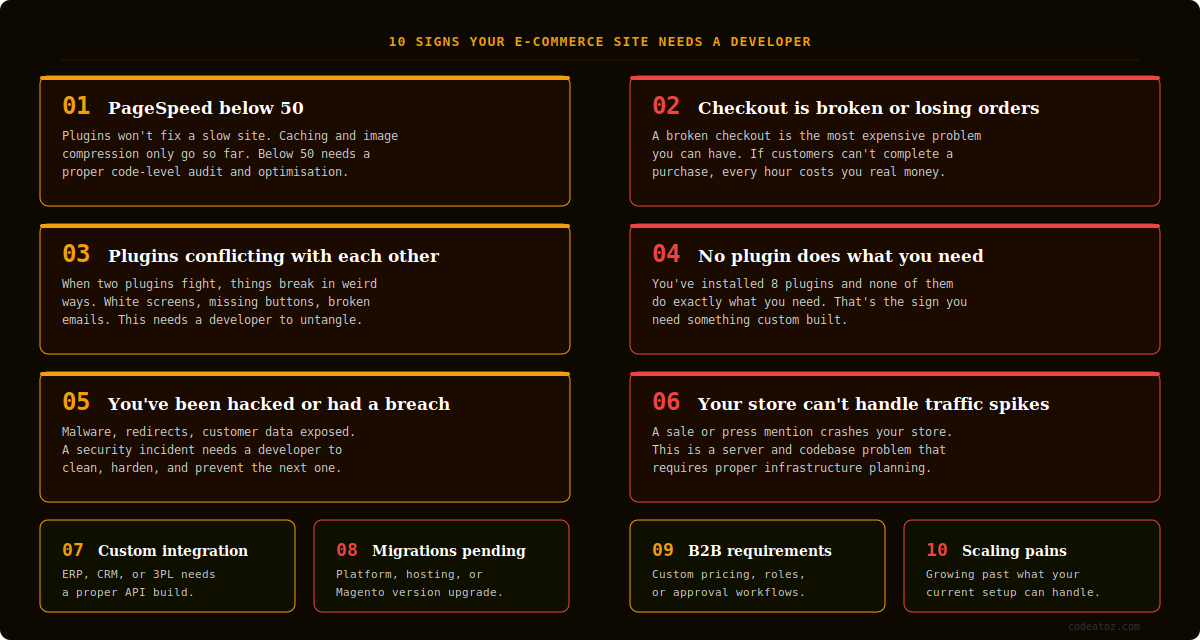
The 10 Signs You Need an E-Commerce Developer
Your PageSpeed score is below 50 and it won’t budge
Caching plugins, image compression, and CDN setup can take a score from 30 to 55 in some cases. But if you’ve done all of that and you’re still stuck below 50, the problem is in the code itself — slow database queries, poorly written custom code, a theme that loads 40 CSS files, or server configuration that needs hands-on attention. No plugin will fix this from the outside. You need an e-commerce developer to audit the code directly.
Your checkout is broken or intermittently losing orders
A broken checkout is the single most expensive problem a store can have. Every minute it’s broken costs real sales. This is never a plugin problem — it’s a code, integration, or hosting issue that needs someone to diagnose it properly. If you’re losing orders and you don’t know why, this needs a WooCommerce developer today, not next week.
Two or more plugins are conflicting and neither vendor will fix it
Plugin vendors are responsible for their own code, not for how it behaves next to someone else’s. When two plugins conflict, both vendors will tell you it’s the other one’s fault. An e-commerce developer can look at both, understand what’s happening at the code level, and either fix the conflict or build a proper solution that does what you need without the collision.
You’ve installed five plugins and none of them do exactly what you need
If you can’t find a plugin that does what you need after thorough searching, there probably isn’t one. The requirement is specific to your business, your workflow, or your customer base. This is exactly what custom development exists for — building the specific thing your store needs rather than compromising with something close-but-not-quite. Sometimes the answer is a purpose-built plugin (we wrote about this when we built our own flash sale plugin rather than cobbling three together).
You’ve been hacked, had malware, or had a data breach
Security incidents don’t fix themselves. If your store has been compromised, you need an e-commerce developer to: remove the malware cleanly, identify how the attacker got in, close that vulnerability, audit for any others, and harden the site against future attacks. Installing a security plugin after the fact is like fitting a lock after the burglary. You need a proper post-incident review first.
Your site crashes or slows dramatically during traffic spikes
If a sale, a press mention, or a social media post takes your store down, that’s a scalability problem. It involves your hosting infrastructure, your database configuration, your caching setup, and potentially your code architecture. Getting this right requires understanding how all those pieces interact — not a plugin.
You need to connect your store to an ERP, CRM, or 3PL
Third-party integrations with systems like SAP, Salesforce, Linnworks, or a custom warehouse system require proper API development. There are off-the-shelf connectors for common combinations, but most serious integrations need custom work to handle your specific data structure, error handling, sync frequency, and edge cases. An e-commerce developer who has done this kind of integration before will spot issues before they hit production.
You’re overdue a platform or version migration
Running Magento 1, PHP 7.x, or an end-of-life WooCommerce version creates compounding security and compatibility risk. Every month you delay makes the migration harder as the gap grows. Migrations are developer work — they require planning, testing, data handling, and careful execution to avoid losing anything. This is exactly the kind of job where a seasoned Magento developer pays for themselves many times over.
You run a B2B store with complex pricing or approval workflows
B2B e-commerce requirements — custom pricing by customer, order approval flows, quote requests, contract pricing, company accounts — go well beyond what standard plugins handle. If you’re managing these manually with workarounds, you’re losing time and creating risk. This is custom development territory. We wrote a dedicated guide on handling B2B pricing properly in WooCommerce if this is you.
Your store is growing and your current setup can’t keep up
A store that was built for 100 orders a month starts showing cracks at 1,000. The architecture, the hosting, the database design — things that were fine at small scale become bottlenecks. Getting ahead of this before it causes problems is far cheaper than fixing it under pressure while the store is struggling. A good e-commerce developer will spot these issues during a planning session, not after your site is on fire.
What Should You Do If You Recognise Any of These?
The honest answer is: don’t guess. Get an e-commerce developer to look at your specific situation and tell you what’s actually going on. A good developer will give you a straight answer about whether something is fixable with existing tools or whether it needs custom work.
We offer a free 30-minute technical audit for any WooCommerce or Magento store. No sales pitch — just an honest diagnosis of what’s going on and what would actually fix it.
E-Commerce Developer vs Plugin Stack — The Real Cost
The most common hesitation we hear is: “I don’t want to spend money on an e-commerce developer when there might be a free plugin that fixes it.”
That’s a reasonable concern. But consider the other side of it:
- A broken checkout losing 5 orders a day at £60 average order value costs £300 a day — an e-commerce developer fixing it in a day pays back immediately
- A security breach can cost far more in recovery, reputation damage, and compliance exposure than the hardening work would have
- Three months of plugin subscriptions that don’t quite solve the problem often costs more than a custom solution built once
- Time you spend personally troubleshooting plugin conflicts is time not spent on marketing, sales, or product — that’s a real hidden cost
The question is never “should I spend money?” — it’s “where does it go further?” Sometimes that’s a plugin. Sometimes it’s an e-commerce developer. The signs above are a good guide for which is which.
Frequently Asked Questions
When should I hire an e-commerce developer instead of using plugins?
Hire an e-commerce developer when your problem is in the code itself, when it crosses multiple plugin boundaries, or when the specific functionality you need doesn’t exist as a plugin. Typical cases: PageSpeed stuck below 50 after plugin tuning, broken checkout losing orders, integrations with ERP/CRM systems, security cleanups, platform migrations, and custom B2B workflows. If you’ve spent more than 4-6 hours searching for a plugin that doesn’t quite fit, a developer will almost always be faster and cheaper.
How much does an e-commerce developer cost?
Rates vary by region and experience. Freelance e-commerce developers in Europe/UK typically charge £40-120 per hour. Agencies charge £80-200 per hour but bring team depth. For scoped projects, budget anywhere from £500 for small fixes to £10,000+ for major custom builds or migrations. Get at least two quotes and ask for clear deliverables, not just hours. A well-scoped fixed-price project is almost always better value than open-ended hourly work.
What should a good e-commerce developer do for a WooCommerce or Magento store?
A good e-commerce developer should diagnose root causes, not just symptoms. They should write code that’s auditable and maintainable, use the platform’s native hooks and filters instead of hacking core files, test changes in staging before production, document what they’ve done, and give you access to the code they wrote. Red flags: vague answers, reluctance to share code, no staging environment, no written scope of work.
Can one e-commerce developer work on both WooCommerce and Magento?
Yes — but it’s not that common. WooCommerce (WordPress/PHP) and Magento 2 (Adobe Commerce/PHP) are both PHP-based but architecturally very different. Magento has steeper learning curves with dependency injection, layout XML, and module systems. A developer who claims deep expertise in both usually does — ask for specific projects on each platform. We work across both, plus Shopify (Liquid) and React frontends, which lets us handle platform migrations and headless setups that single-platform developers can’t.
How do I find a reliable e-commerce developer?
Start with referrals from other store owners in your network — a good e-commerce developer almost always comes recommended. Failing that, look at GitHub for public code samples, check WordPress.org/Magento Marketplace for plugins they’ve published, read reviews on Clutch or Trustpilot, and always request a free initial call before committing. The best signal is how they diagnose your problem on that first call — a good developer asks specific technical questions; a bad one jumps straight to a quote.
What’s the difference between an e-commerce developer and a web designer?
A web designer focuses on visual design, user experience, and the look of the store — colours, typography, layout, conversion-focused UX. An e-commerce developer focuses on functionality and code — performance, integrations, custom features, security, database structure, and platform-specific work. Many projects need both, but they’re distinct skills. A designer can’t fix a broken checkout; a developer can’t always design a beautiful storefront. The best agencies have both on the team.
Not Sure Which Category You’re In?
Book a free 30-minute technical audit. We’ll look at your store, tell you what’s actually causing the problem, and give you an honest recommendation — whether that’s a plugin, an e-commerce developer, or something else entirely.




