
Edge Rendering for Ecommerce — Speed, SEO and Personalisation 2026
Edge rendering runs your storefront code at hundreds of locations near each buyer — sub-50ms TTFB, edge personalisation, and V8 isolates with no cold start.
Edge rendering moves your storefront’s server code out of a single origin region and runs it at hundreds of points of presence close to each shopper. For ecommerce, edge rendering means a buyer in Sydney and a buyer in London both get sub-50ms time-to-first-byte from a server near them, not a round-trip to a datacentre on another continent. Combined with edge personalisation, edge rendering delivers the freshness of server-side rendering at close to static speed.
Search intent: informational with architecture-decision intent — developers and technical leads evaluating where to run storefront rendering. We cover how edge rendering works, the V8 isolate model that makes it fast, edge personalisation for geo and currency, the real constraints, and when it genuinely pays off versus origin rendering. This connects directly to your rendering strategy and CDN architecture decisions.
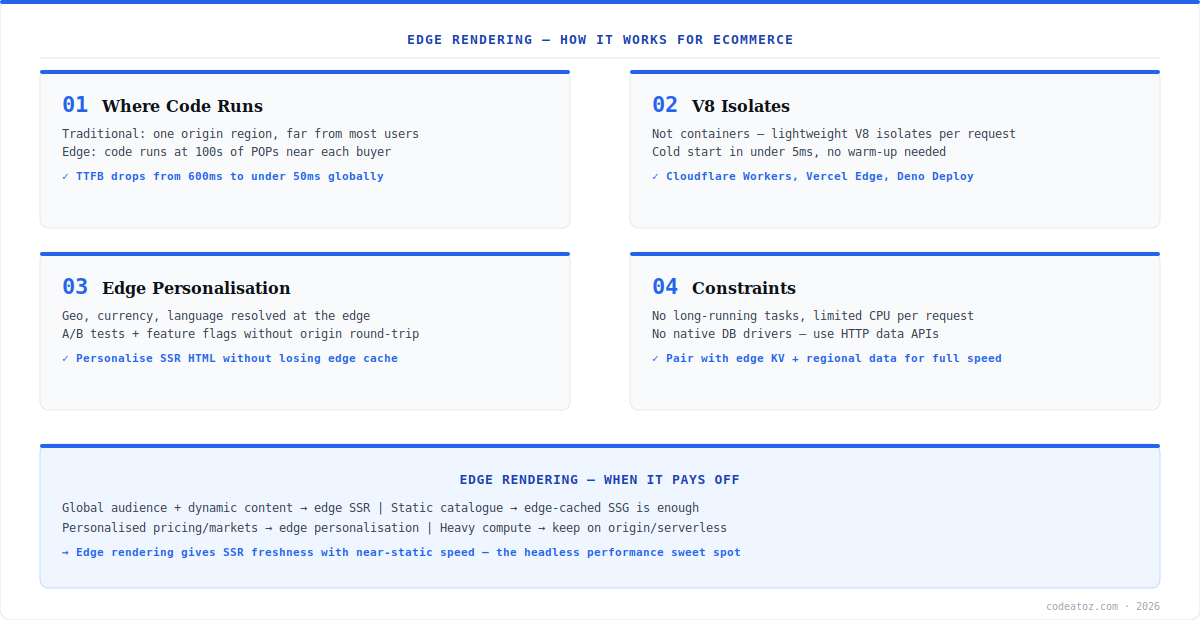
How Edge Rendering Works: V8 Isolates
Traditional server rendering runs in one region; every request from a distant user pays the network round-trip. Edge rendering instead executes your code in lightweight V8 isolates distributed across a global network. Isolates are not containers or VMs — they share a runtime and spin up in under 5ms with no cold-start penalty, which is what makes per-request edge rendering economical at scale. Platforms like Cloudflare Workers, Vercel Edge Functions and Deno Deploy all run this model. The trade is a constrained runtime: limited CPU time per request and no native binary dependencies.
Edge Rendering: Personalisation Without Losing Speed
The ecommerce superpower of edge rendering is personalisation at the edge. Geo-detection, currency selection, language, A/B test bucketing and feature flags all resolve at the edge node before HTML is generated — so a shopper sees their local currency and market-appropriate content with no origin round-trip and no client-side flicker. This is how edge rendering reconciles two things that usually conflict: personalised SSR content and edge-cached speed. Pair it with platform internationalisation like Shopify Markets context, and the storefront localises per visitor at the edge. The Cloudflare Workers documentation covers the isolate runtime in depth.
| Concern | Origin rendering | Edge rendering |
|---|---|---|
| Global TTFB | 200-600ms (region-dependent) | Under 50ms (near user) |
| Cold start | Containers/VMs, seconds | V8 isolates, under 5ms |
| Personalisation | Round-trip to origin | Resolved at the edge node |
| Heavy compute | Unlimited CPU/memory | Constrained per request |
| Data access | Native DB drivers | HTTP data APIs + edge KV |
Edge Rendering: Constraints and When It Pays Off
Edge rendering is not free of trade-offs. The constrained runtime means no long-running tasks, capped CPU per request, and no native database drivers — edge code reaches data through HTTP APIs and edge key-value stores rather than direct connections. Heavy computation (report generation, image processing) belongs on origin or serverless functions, not the edge. Edge rendering pays off clearly when you have a global audience with dynamic or personalised content; for a purely static catalogue, edge-cached static generation already delivers the speed without the runtime constraints. Our performance engineering team designs the edge/origin split so the right work runs in the right place.
What edge rendering looks like in real builds
The data layer is where edge projects succeed or fail. Teams move rendering to the edge, then try to reach a database in one region and lose all the latency benefit on the data call. We architect edge storefronts around HTTP data APIs and edge KV, with regional read replicas where direct data is unavoidable.
Edge personalisation is the feature that justifies the move. If your store is global and shows the same content to everyone, edge-cached static is simpler and just as fast. We recommend edge rendering specifically when geo, currency or experimentation must vary per request without a flicker.
Keep heavy work off the edge. The most common production incident we see is a CPU-bound task hitting the edge runtime’s limit. PDF generation, large data transforms and image work belong on serverless or origin — the edge renders the page, it does not do the batch job.
Frequently Asked Questions About Edge Rendering
What is edge rendering in ecommerce?
Edge rendering runs your storefront’s server code at hundreds of points of presence near each shopper instead of a single origin region. For ecommerce it means sub-50ms time-to-first-byte globally and the ability to personalise content (geo, currency, language) at the edge without an origin round-trip.
What are V8 isolates in edge rendering?
V8 isolates are lightweight execution contexts that share a runtime rather than running as separate containers or VMs. They start in under 5ms with no cold-start penalty, which is what makes per-request edge rendering economical. Cloudflare Workers, Vercel Edge and Deno Deploy all use the isolate model.
How does edge rendering enable personalisation?
Edge rendering resolves geo-detection, currency, language, A/B bucketing and feature flags at the edge node before generating HTML — so shoppers see localised, personalised pages with no origin round-trip and no client-side flicker. This reconciles personalised server rendering with edge-cached speed.
What are the constraints of edge rendering?
Edge runtimes cap CPU time per request, disallow long-running tasks, and lack native database drivers — edge code reaches data via HTTP APIs and edge key-value stores. Heavy computation like report or image generation must run on origin or serverless functions rather than at the edge.
When should I use edge rendering for my store?
Use edge rendering when you have a global audience with dynamic or personalised content — varying currency, market, or experiments per request. For a purely static catalogue with identical content for everyone, edge-cached static generation already delivers the speed without the edge runtime’s constraints.
Which platforms support edge rendering?
Cloudflare Workers, Vercel Edge Functions, Netlify Edge Functions and Deno Deploy all support edge rendering on the V8 isolate model. Frameworks like Next.js, Astro and Remix can target these edge runtimes for specific routes, letting you run edge rendering where it helps and origin rendering where it does not.
Taking Your Storefront to the Edge?
Our team designs the edge/origin split — edge rendering for speed and personalisation, origin for heavy work.




