
Ecommerce Agency vs Freelancer vs In-House — Who Should Build Your Store?
The ecommerce agency vs freelancer vs in-house decision has no single right answer — each fits different work. Here is how to match the hiring model to the job in front of you.
The ecommerce agency vs freelancer vs in-house question is one every growing store faces, and the honest answer is that none of the three is universally best — each suits different kinds of work, budgets and stages. A freelancer is ideal for a bounded task, an agency for a complex build or ongoing partnership, an in-house team for a store where commerce is the core business at scale. Choosing well in the ecommerce agency vs freelancer decision is about matching the model to the job, not picking a favourite. This guide sets out the trade-offs.
Search intent: decisional — merchants deciding who should build or maintain their store. We cover why there is no single answer, the strengths and risks of freelancers, agencies and in-house teams, and how to choose. It builds on our how to hire an ecommerce developer guide and Magento development cost guide.
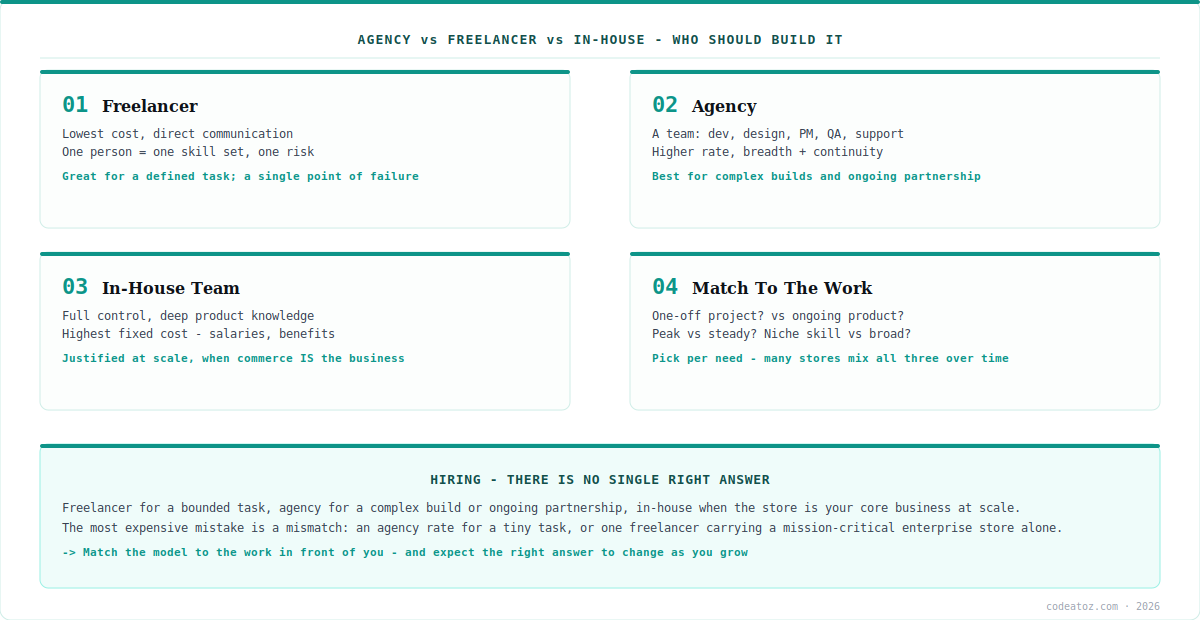
Ecommerce Agency vs Freelancer vs In-House: No Single Answer
The reason the ecommerce agency vs freelancer vs in-house question resists a single answer is that the three models optimise for different things. A freelancer optimises for cost and directness; an agency for breadth, continuity and capacity; an in-house team for control and deep product knowledge. Which of those you need depends entirely on the work — and the same business may need different models for different jobs, or the same job at different stages of growth.
The most expensive mistake in the ecommerce agency vs freelancer decision is a mismatch: paying an agency’s rate for a task a freelancer could handle, or asking a single freelancer to carry a mission-critical enterprise store that needs a team. Getting this right is less about which model is “best” and more about diagnosing what the specific work actually requires, then choosing the model that fits it. The rest of this guide is that diagnosis.
Ecommerce Agency vs Freelancer: The Freelancer Case
On the freelancer side of the ecommerce agency vs freelancer comparison, the appeal is clear: lower cost, direct communication with the person doing the work, and flexibility. For a well-defined, bounded task — a specific feature, a design refresh, a plugin, a fixed piece of development — a good freelancer is often the most efficient and economical choice. You are paying one skilled person for exactly the work you need, with no agency overhead.
The risks are equally clear. A freelancer is a single person with a single skill set, so a project needing design and backend and project management stretches beyond what one person does well. They are also a single point of failure — illness, unavailability or simply moving on can leave a project or, worse, a live store stranded. For the ecommerce agency vs freelancer decision, the freelancer wins when the work is bounded, the skill needed is singular, and the store is not so critical that one person’s unavailability is a business risk. For anything larger or more critical, that single-point-of-failure risk grows.
Ecommerce Agency vs Freelancer: Agency and In-House
An agency answers the ecommerce agency vs freelancer question when you need a team. An agency brings multiple disciplines — development, design, project management, QA, ongoing support — under one roof, with the continuity that a single freelancer cannot offer: if one person is unavailable, the work continues. For a complex build, a migration, or an ongoing partnership where you want a team that knows your store over years, the agency model earns its higher rate through breadth, capacity and reliability. The trade-off is cost (you pay for that team and overhead) and slightly less directness than working with one person.
An in-house team is the right answer to the ecommerce agency vs freelancer vs in-house decision when ecommerce is your business at scale. Hiring your own developers gives maximum control, the deepest possible product knowledge, and people fully dedicated to your store — but at the highest fixed cost, since salaries, benefits and management are ongoing whether or not there is a full pipeline of work. In-house makes sense once your store is large enough to keep a team continuously busy and strategic enough that the control justifies the cost. Below that threshold, the fixed cost of idle capacity makes an agency or freelancer more economical.
| Factor | Freelancer | Agency | In-House |
|---|---|---|---|
| Cost model | Lowest, per-task | Mid, team rate | Highest, fixed |
| Skill breadth | Single | Multi-discipline | Multi, dedicated |
| Continuity | Single point of failure | Team resilience | Highest (if retained) |
| Product knowledge | Task-level | Deep over time | Deepest |
| Best for | Bounded tasks | Complex + ongoing | Commerce at scale |
| Main risk | Availability | Cost, directness | Idle fixed cost |
Most stores mix all three over time. The ecommerce agency vs freelancer vs in-house choice is rarely permanent or exclusive. A common pattern: a freelancer for early bounded tasks, an agency as the build grows complex and needs a team, and an in-house hire or two once the store is large enough to justify dedicated staff — often keeping an agency relationship for specialist work alongside. Match the model to the work now, and expect the right answer to evolve.
Ecommerce Agency vs Freelancer vs In-House: How to Choose
To decide the ecommerce agency vs freelancer vs in-house question for a given need, ask a few concrete questions. Is this a one-off task or ongoing work? A bounded task leans freelancer; ongoing work leans agency or in-house. Does it need one skill or several? One skill leans freelancer; several lean agency or in-house. How critical is the store? A mission-critical store makes single-point-of-failure risk unacceptable, pushing toward a team. And how large and continuous is the work? Enough to keep a team busy full-time leans in-house; intermittent leans agency or freelancer.
Run those questions and the right model usually emerges. The goal of the ecommerce agency vs freelancer decision is not to find the cheapest option or the most impressive one, but the one that fits the work — because a mismatch costs more than the right choice at any price point. Our guide to hiring an ecommerce developer covers how to evaluate candidates once you have chosen a model, and our team works as the agency option for merchants who need breadth, continuity and a partner that knows their store over the long term.
How we see the agency vs freelancer vs in-house choice
We are honest about when a freelancer is the better fit. As an agency, we could take every job, but for a small, bounded task a good freelancer is often the more sensible choice — and we say so. Steering a client to an agency engagement they do not need is exactly the mismatch that makes hiring expensive.
Continuity is what clients value most in the agency model. The single biggest reason merchants move from a freelancer to us is a bad experience with a single point of failure — a developer who vanished mid-project or left a live store unsupported. A team that continues regardless of any one person’s availability is the agency model’s core value.
In-house plus agency is a common, healthy pattern. Larger clients often have their own developers and still keep us for specialist work — a Magento performance deep-dive, a migration, a security response. The models are not mutually exclusive; the right structure at scale frequently blends dedicated in-house staff with agency depth on demand.
Frequently Asked Questions About Agency vs Freelancer vs In-House
Should I hire an agency, freelancer or in-house team?
It depends on the work. A freelancer suits a bounded, single-skill task; an agency suits a complex build or ongoing partnership needing multiple disciplines and continuity; an in-house team suits a store where commerce is your core business at scale. The ecommerce agency vs freelancer vs in-house choice is about matching the model to the job, not picking a favourite.
Is a freelancer cheaper than an agency?
Per hour, usually yes — there is no team or overhead to pay for. But cheaper is not always better value: a freelancer is a single skill set and a single point of failure. For a bounded task the lower cost is real savings; for a complex or mission-critical build, the risk of one person carrying it can cost far more than an agency’s rate.
When does an in-house team make sense?
When ecommerce is your core business at scale — large enough to keep developers continuously busy and strategic enough that maximum control and deep product knowledge justify the highest fixed cost. Below that threshold, salaries and benefits for staff without a full pipeline of work make an agency or freelancer more economical. In-house is a scale decision.
What is the biggest risk with a freelancer?
Being a single point of failure. A freelancer is one person, so illness, unavailability or moving on can strand a project or leave a live store unsupported. They also cover a single skill set, so multi-discipline work stretches beyond them. For bounded tasks on non-critical stores this is fine; for critical stores it is a real business risk.
Can I use more than one model at once?
Yes, and most growing stores do over time. A common pattern is a freelancer for early bounded tasks, an agency as builds grow complex, and eventually in-house hires once the store justifies dedicated staff — often keeping an agency relationship for specialist work alongside in-house developers. The models are not mutually exclusive; blend them as your needs evolve.
How do I choose between the three for a specific project?
Ask: is it one-off or ongoing? One skill or several? How mission-critical is the store? How continuous is the work? Bounded, single-skill, non-critical work leans freelancer; complex, multi-skill or ongoing work leans agency; large continuous work on a core-business store leans in-house. The answers usually point clearly to the right model.
Need a Team That Fits Your Work?
Our team is the agency option — multi-discipline, continuous, and honest about when a freelancer would serve you better.




