
The Complete Composable Commerce Guide — MACH & PBCs 2026
Composable commerce builds your store from best-of-breed, independently swappable services on MACH architecture — microservices, API-first, cloud-native, headless.
Composable commerce is an architectural approach where you assemble your ecommerce platform from independent, best-of-breed services — search from one vendor, payments from another, CMS from a third — connected by APIs rather than locked into a single monolith. Coined by Gartner, composable commerce takes headless one step further: instead of just decoupling frontend from backend, it decomposes the backend itself into swappable Packaged Business Capabilities (PBCs) on MACH architecture.
Search intent: informational with strategic-decision intent — architects and technical leaders evaluating whether to move from a monolith to a composable stack. We cover what composable commerce is, the MACH foundation, PBCs, how it differs from headless, and the honest trade-offs. This builds on our commerce architecture cluster and connects to platform choices like CommerceTools vs Shopify.
What Composable Commerce Is: MACH and PBCs
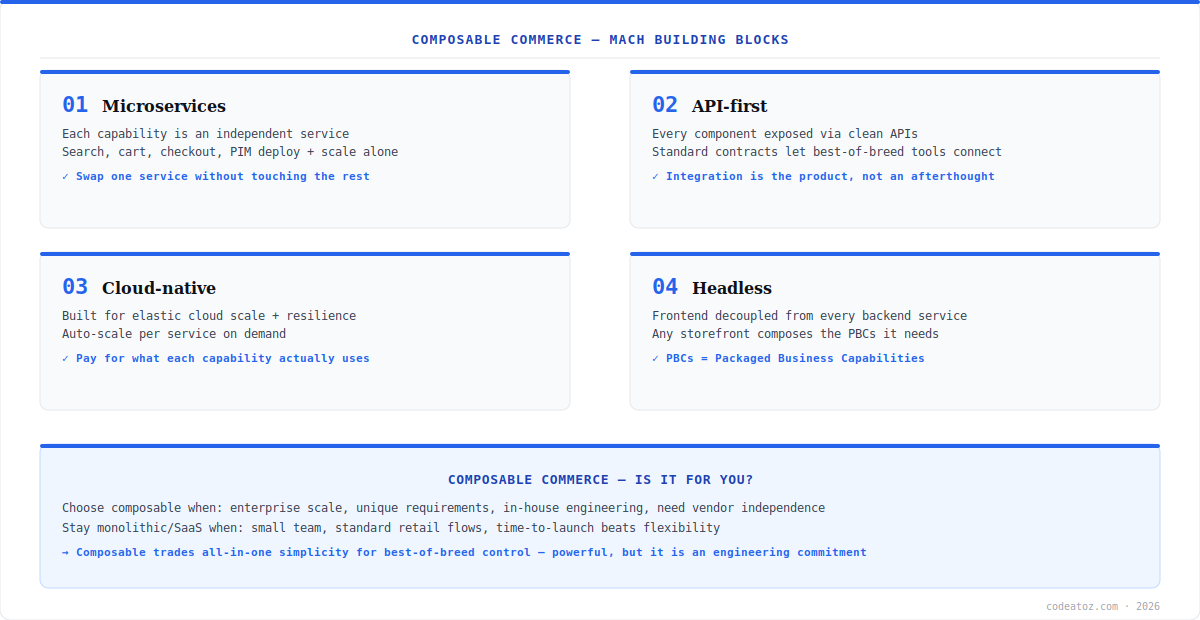
Composable commerce rests on MACH architecture: Microservices (each capability is an independent, separately deployable service), API-first (every component exposes clean APIs as its primary interface), Cloud-native (built for elastic scale and resilience), and Headless (the frontend is fully decoupled). The units you assemble are PBCs — Packaged Business Capabilities like search, cart, checkout, PIM, or promotions — each independently deployable and swappable. The promise of composable commerce: replace your search provider without touching checkout, scale inventory independently of the storefront, and never be held hostage by a single vendor’s roadmap.
Composable Commerce vs Headless: The Difference
People conflate the two, but composable commerce and headless are not the same. Headless decouples one thing: frontend from backend. Composable commerce decouples everything: it breaks the backend itself into independent services you mix and match. Every composable store is headless, but not every headless store is composable — a headless WooCommerce build with a Next.js frontend is headless, yet WooCommerce remains a monolith behind the API. True composable commerce would replace that monolith with discrete services. This is why composable is described as “headless taken to its logical conclusion” — the same decoupling principle applied at every layer. The MACH Alliance maintains the reference definitions, and our Medusa guide covers an open-source path toward composable.
| Aspect | Headless | Composable Commerce |
|---|---|---|
| Decouples | Frontend from backend | Every backend capability |
| Backend | Often still a monolith | Independent PBCs/services |
| Vendor lock-in | Reduced on frontend | Minimised across the stack |
| Complexity | Moderate | High — many services to integrate |
| Best for | Custom storefronts | Enterprise, unique requirements |
Composable Commerce: When It’s Worth It
Composable commerce is powerful but it is not free — it trades all-in-one simplicity for best-of-breed control, and that control is an engineering commitment. Choose composable commerce when you operate at enterprise scale, have genuinely unique requirements a packaged platform fights, run an in-house engineering team, and need vendor independence as a strategic priority. Stay with a monolith or SaaS like Shopify or Magento when your team is small, your flows are standard retail, and time-to-launch matters more than ultimate flexibility. The Gartner PBC definition frames the strategy, and technology radars track the tooling maturity. Our commerce engineering team helps teams decide if composable is the right move before committing.
What composable commerce really demands
The integration surface is the hidden cost. Teams are sold on swappable best-of-breed services, then discover that five vendors means five APIs, five SLAs, five failure modes, and an orchestration layer someone has to own. Composable shifts effort from “configuring a platform” to “integrating and operating a system” — budget for that.
Start composable at the edges, not the core. The pattern that works: keep a solid commerce core and peel off one capability at a time (search first, then CMS, then promotions) rather than a big-bang rebuild. This de-risks the move and proves value incrementally.
Most mid-market stores do not need full composable. We regularly advise clients that a well-built headless setup on a single strong platform delivers 80% of the benefit at a fraction of the operational cost. Composable earns its complexity at scale and with truly bespoke requirements — not as a default.
Frequently Asked Questions About Composable Commerce
What is composable commerce?
Composable commerce is an architecture where you assemble your ecommerce platform from independent, best-of-breed services (Packaged Business Capabilities) connected by APIs, rather than using one monolithic platform. It is built on MACH — microservices, API-first, cloud-native, headless — and lets you swap any capability without rebuilding the whole system.
What is the difference between composable commerce and headless?
Headless decouples the frontend from the backend. Composable commerce goes further and decouples every backend capability into independent services. Every composable store is headless, but a headless store can still run on a backend monolith — composable commerce replaces that monolith with discrete, swappable PBCs.
What does MACH stand for in composable commerce?
MACH stands for Microservices, API-first, Cloud-native, and Headless — the four architectural principles underpinning composable commerce. Microservices make each capability independent, API-first makes integration the primary interface, cloud-native enables elastic scale, and headless decouples the presentation layer.
What are PBCs in composable commerce?
PBCs (Packaged Business Capabilities) are the building blocks of composable commerce — self-contained units of business functionality like search, cart, checkout, PIM or promotions. Each is independently deployable and swappable, so you assemble best-of-breed PBCs from different vendors into one custom commerce platform.
Is composable commerce right for small businesses?
Usually not. Composable commerce shines at enterprise scale and for businesses with unique requirements and in-house engineering. Small and mid-market stores typically get most of the benefit from a well-built headless setup on one strong platform, without the integration and operational overhead of running many independent services.
How do I start moving to composable commerce?
Start at the edges, not the core. Keep your commerce core and peel off one capability at a time — replace search first, then CMS, then promotions — proving value incrementally. This de-risks the transition compared with a big-bang rebuild and lets you build the integration and operational muscle composable commerce requires.
Evaluating Composable Commerce?
Our team helps you decide if composable is right — and builds the incremental path if it is.




