
B2B Pricing — Customer-Specific and Tiered Pricing in 2026
B2B pricing is rarely one price. The same product can cost different amounts for different buyers — trade tiers, negotiated contracts, volume breaks, often hidden until login. That complexity is what most separates B2B platforms.
B2B pricing is where B2B commerce diverges most sharply from B2C, and where platform choice is most tested. A consumer store shows one price to everyone; a B2B store shows your price — which depends on who you are, what you have negotiated, how much you buy and whether you have even logged in. This layered, customer-specific B2B pricing is not an unusual requirement in B2B; it is the norm, and handling it well is one of the hardest and most decisive parts of building a B2B store. This guide breaks down the layers and what they demand of your platform.
Search intent: informational — B2B merchants and developers designing pricing structures. We cover why B2B pricing is complex, the layers (group, contract, volume), price gating, the platform implications, and getting it right. It builds on our B2B ecommerce platform guide and WooCommerce wholesale pricing guide.
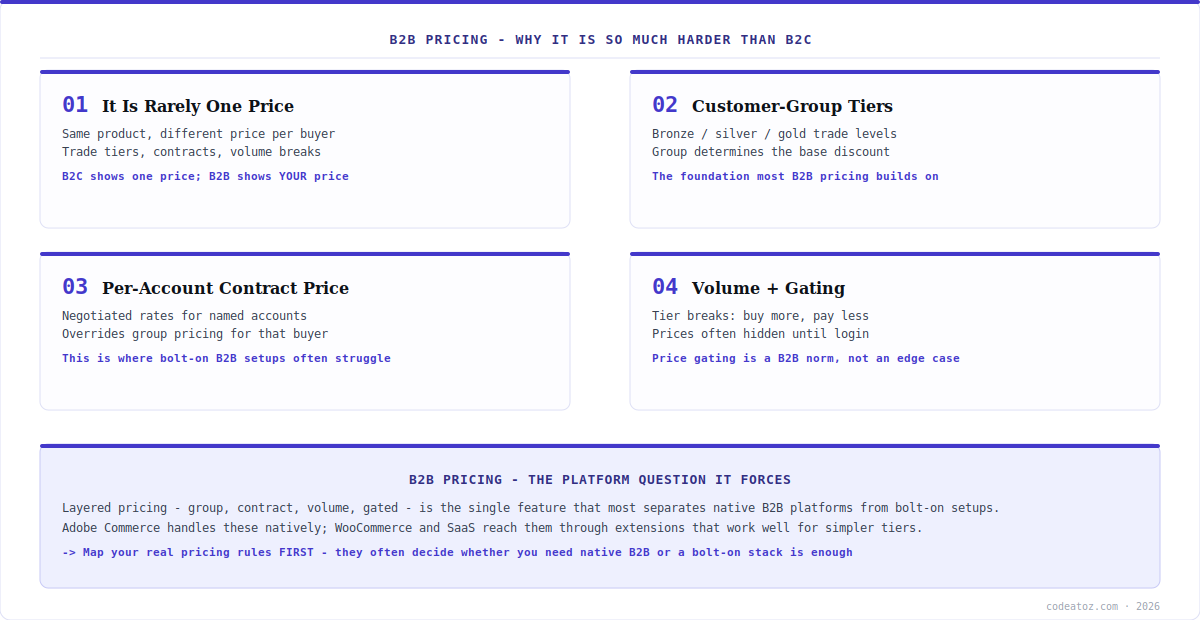
B2B Pricing: Why It Is So Much Harder Than B2C
The core reason B2B pricing is hard is that there is no single price. In B2C, a product has a price and everyone pays it. In B2B, the same product might sell at the list price to a new customer, at a trade discount to a wholesale account, at a further-negotiated rate to a large contracted buyer, and at a volume-adjusted price for a big order — all simultaneously, all correct. The platform has to know who is asking and show the right price for them.
This multiplicity is the essence of the B2B pricing challenge. It is not just “discounts” — it is a structured system where a buyer’s identity, group, contract and order quantity all feed into the price they see. And often the price is hidden entirely until the buyer logs in, because published pricing would reveal negotiated rates to competitors or confuse retail visitors. Building this correctly means the platform must support layered, identity-aware B2B pricing as a core capability, not a discount plugin. Getting it wrong means buyers see the wrong prices — a serious commercial error.
B2B Pricing: The Layers That Stack Up
B2B pricing is best understood as layers that stack. At the base is the catalogue list price — the default. On top sits customer-group pricing: buyers are grouped (bronze, silver, gold trade tiers, or by segment) and each group gets its pricing, usually a discount structure off the base. This is the foundation most B2B pricing builds on, and for many businesses, group pricing plus gating is enough.
Above group pricing come per-account contract prices: specific negotiated rates for named accounts that override their group’s pricing. A major buyer might have individually agreed prices on key products, separate from any group. Then volume or tier breaks: buy more, pay less, with price dropping at quantity thresholds. A complete B2B pricing system resolves all these layers correctly for any given buyer and order — group as the base, contract overrides where they exist, volume adjustments on top. The complexity is real, and it is exactly why B2B pricing is one of the hardest things to get right in a B2B build, and where bolt-on setups most often struggle.
| Pricing layer | What it does | Complexity |
|---|---|---|
| Base list price | Default catalogue price | Simple |
| Customer-group pricing | Trade tiers get their discount | Moderate — the foundation |
| Per-account contract price | Named accounts’ negotiated rates | High — overrides groups |
| Volume / tier breaks | Buy more, pay less | Moderate |
| Price gating | Hidden until login | Moderate — a B2B norm |
B2B Pricing: Price Gating and Why B2B Hides Prices
Price gating — hiding prices until a buyer logs in or is approved — is a B2B pricing practice that puzzles people from a B2C background but is entirely rational in B2B. There are good reasons. Negotiated and trade pricing is often commercially sensitive: a business does not want competitors seeing the rates it offers, or one customer seeing another’s better deal. Published prices can also confuse — a retail visitor seeing wholesale pricing, or a buyer seeing a price that is not theirs. And gating supports a sales process where pricing follows a relationship or an account approval.
So B2B stores commonly hide prices from anonymous visitors, showing “login to see price” or “request a quote” instead, and reveal the correct B2B pricing once the buyer is identified. This is well-trodden ground with mature solutions — our WooCommerce guides on login to see price and hiding prices cover the patterns. The key point is that price gating is a standard, expected part of B2B pricing, not an obstacle — it is how B2B protects commercially sensitive pricing while still presenting a full catalogue.
B2B pricing complexity is the clearest platform decider. Layered B2B pricing — group, contract, volume, gated — is the single feature that most separates native B2B platforms from bolt-on setups. Simple group pricing and gating are well handled by WooCommerce and Shopify extensions. Intricate per-account contract pricing layered with volume breaks and approval-based gating is where native platforms like Adobe Commerce pull ahead. Map your real pricing rules first; they often decide your platform.
B2B Pricing: Platform Impact and Getting It Right
Because B2B pricing complexity varies so much between businesses, it is the requirement that most influences platform choice, as our B2B platform guide explains. A native B2B platform like Adobe Commerce handles group pricing, per-account contracts, volume tiers and gating as integrated native features. WooCommerce and Shopify reach group pricing and gating well through extensions, and can handle contract pricing with more effort, but the more layers you stack, the harder a bolt-on approach works.
Getting B2B pricing right therefore starts with mapping your actual pricing rules before choosing anything: what groups exist, whether named accounts have contract prices, whether volume breaks apply, whether prices are gated. That map tells you both how complex your B2B pricing is and which platform suits it. Then implement it so the right buyer always sees the right price — the commercial stakes of getting this wrong (a buyer seeing another’s contract price, or wrong pricing on an order) are high. Done well, layered B2B pricing is invisible to the buyer, who simply sees their correct price. Our team designs and builds B2B pricing structures, native and bolt-on, matched to each client’s real rules.
How we approach B2B pricing
We map every pricing rule before touching a platform. B2B pricing is where projects go wrong when the rules are not fully understood upfront. We document every layer — groups, contracts, volume breaks, gating — because that map both reveals the true complexity and often decides the platform before any other requirement does.
Per-account contract pricing is the stress test. Group pricing and gating are straightforward on most platforms; individually negotiated per-account prices layered over groups are where bolt-on setups strain. We test a client’s contract-pricing needs specifically, because that layer, more than any other, signals whether native B2B is warranted.
We treat correctness as a commercial priority, not just a technical one. A buyer seeing the wrong price — another account’s contract rate, or a figure that is not theirs — is a real commercial problem, not a cosmetic bug. We build and test pricing resolution carefully, because in B2B, showing the right person the right price is the whole job.
Frequently Asked Questions About B2B Pricing
Why is B2B pricing so complex?
Because there is no single price. The same product can sell at list price to a new customer, a trade discount to a wholesale account, a negotiated rate to a contracted buyer, and a volume-adjusted price for a large order — all at once, all correct. The platform must know who is asking and show their price, often hidden until login. That layered, identity-aware pricing is inherently complex.
What are the layers of B2B pricing?
Base list price is the default. Customer-group pricing gives trade tiers (bronze, silver, gold, or by segment) their discount — the foundation most B2B pricing builds on. Per-account contract pricing gives named accounts negotiated rates that override groups. Volume or tier breaks reduce price at quantity thresholds. Price gating hides prices until login. A complete system resolves all layers per buyer.
Why do B2B stores hide prices until login?
Several reasons: negotiated and trade pricing is commercially sensitive, so businesses avoid competitors or other customers seeing their rates; published wholesale prices can confuse retail visitors; and gating supports a sales process where pricing follows an account relationship or approval. Showing “login to see price” or “request a quote” and revealing the correct price once identified is a standard B2B norm.
Does B2B pricing complexity affect platform choice?
Significantly — it is often the clearest decider. Simple customer-group pricing and gating are handled well by WooCommerce and Shopify extensions. Intricate per-account contract pricing layered with volume breaks and approval-based gating is where native platforms like Adobe Commerce pull ahead. Mapping your real pricing rules often decides whether you need native B2B or a bolt-on stack suffices.
Can WooCommerce handle customer-specific B2B pricing?
Yes, to a point. WooCommerce handles customer-group (trade tier) pricing and price gating well through extensions, and can do volume pricing. Per-account contract pricing — individually negotiated rates overriding groups — is achievable but harder and more extension-dependent. For simpler B2B pricing WooCommerce works well; for many layered per-account contracts, native B2B fits better.
How do I set up B2B pricing correctly?
Map your actual pricing rules first: what customer groups exist, whether named accounts have contract prices, whether volume breaks apply, whether prices are gated. That map reveals your complexity and suits a platform to it. Then implement so the right buyer always sees the right price, and test resolution carefully — showing a buyer the wrong price is a serious commercial error, not a cosmetic one.
Building B2B Pricing That Works?
Our team maps your pricing rules and builds layered B2B pricing — group, contract, volume, gated — so every buyer sees their correct price.




