
The Complete Shopify Metaobjects Guide 2026
Shopify metaobjects let you model custom, reusable structured content — definitions, fields, reference fields and Storefront API access — beyond what metafields offer.
Shopify metaobjects are Shopify’s content-modelling feature — they let you define your own custom, structured content types (think “Author”, “Size guide”, “Ingredient”) with typed fields, then create reusable entries you reference across products, pages and themes. Where metafields add extra fields to existing resources, Shopify metaobjects are standalone content objects of your own design, turning Shopify into a light structured-content platform without a separate CMS (the Metaobject API exposes it programmatically).
Search intent: informational/procedural — Shopify developers and merchants modelling custom content. We cover what Shopify metaobjects are, definitions and fields, reference fields, Storefront API access, how they differ from metafields, and real use cases. It connects to our Storefront API and headless CMS guides.
Shopify Metaobjects: Definitions and Fields
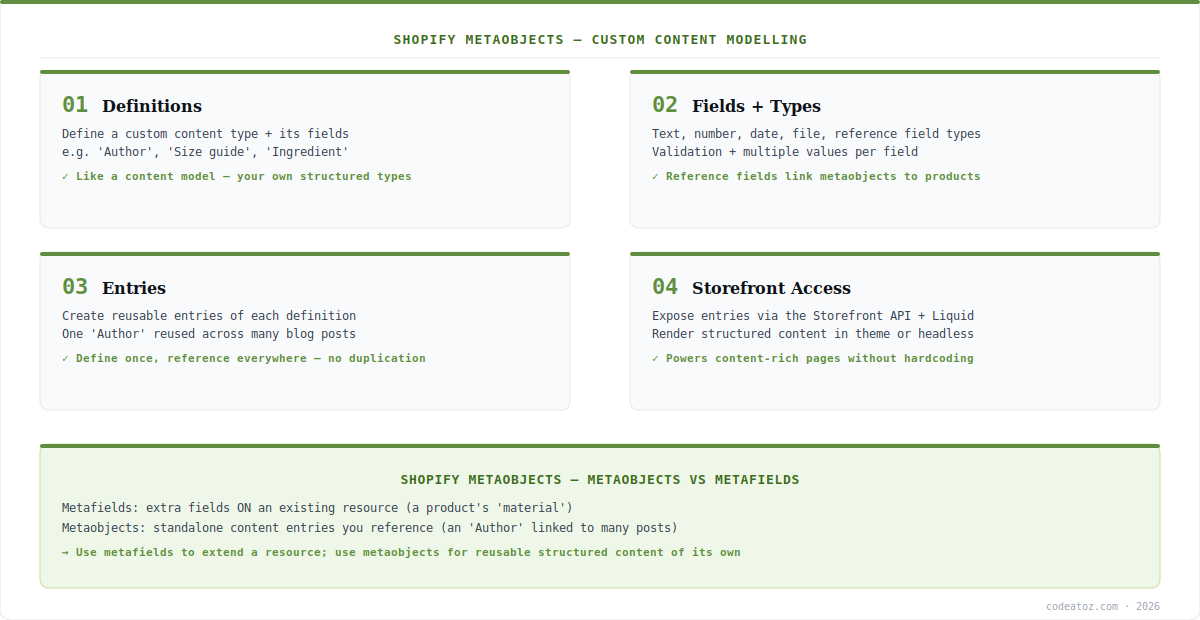
You start with a Shopify metaobjects definition — a custom content type and the fields it contains. Define “Author” with fields for name, bio, photo and social links; or “Size guide” with a table and notes. Fields are typed (text, number, date, file, reference, and more), can validate input, and can hold multiple values. This is exactly like designing a content model in a headless CMS — you describe the shape of your content, and Shopify metaobjects enforce it. Once a definition exists, you create entries of it, each a reusable piece of structured content.
Shopify Metaobjects: References and Storefront Access
The power of Shopify metaobjects comes from reference fields and reuse. A reference field links a metaobject entry to a product, a page, or another metaobject — so one “Author” entry is referenced by many blog posts, one “Ingredient” entry by many products, with no duplication. Update the entry once and every reference reflects it. For display, Shopify metaobjects are accessible both in Liquid themes and through the Storefront API, so they render in standard themes and in headless storefronts alike. This makes them the structured-content backbone for content-rich Shopify stores. The metaobjects documentation and metaobjects manual cover setup.
| Aspect | Metaobjects | Metafields |
|---|---|---|
| What it is | Standalone content entry | Extra field on a resource |
| Example | An “Author” reused widely | A product’s “material” value |
| Reuse | Referenced by many resources | Belongs to one resource |
| Best for | Reusable structured content | Extending existing objects |
| Storefront access | Liquid + Storefront API | Liquid + Storefront API |
Shopify Metaobjects: Metafields and Real Use Cases
The key distinction: metafields add a field to an existing resource (a product’s “material”), while Shopify metaobjects are reusable content entities of their own that you reference. Use metafields to extend a resource; use Shopify metaobjects for reusable structured content with its own lifecycle. Real use cases: author profiles referenced across a blog, size guides shared by product families, ingredient or material libraries, store-locator entries, FAQ blocks, and reusable promotional banners. With Shopify metaobjects plus the Storefront API, many stores avoid a separate headless CMS for structured content entirely — see our headless CMS guide for when you still need one. Our Shopify team models content with metaobjects.
What we have learned using Shopify metaobjects
Metaobjects often replace a headless CMS for structured content. For authors, size guides, ingredient libraries and similar reusable content, native metaobjects plus the Storefront API do the job without adding a Sanity or Contentful dependency. We reach for a dedicated CMS only when editorial workflow and preview demands exceed what metaobjects offer.
Reference fields are where the value is. The mistake we see is duplicating the same content across products instead of creating one metaobject entry and referencing it. Model reusable concepts as metaobjects and reference them — update once, reflect everywhere.
Plan definitions before creating entries. Metaobject definitions are your content model; designing fields and references up front prevents painful restructuring later. We treat metaobject schema design with the same care as a database schema.
Frequently Asked Questions About Shopify Metaobjects
What are Shopify metaobjects?
Shopify metaobjects are a content-modelling feature that lets you define custom, structured content types with typed fields, then create reusable entries you reference across products, pages and themes. They turn Shopify into a light structured-content platform — for example modelling authors, size guides or ingredient libraries natively.
What is the difference between metaobjects and metafields?
Metafields add extra fields to an existing resource — like a product’s “material” value. Shopify metaobjects are standalone, reusable content entries of your own design that you reference from many resources. Use metafields to extend a resource; use metaobjects for reusable structured content with its own lifecycle.
Can Shopify metaobjects be accessed via the Storefront API?
Yes. Shopify metaobjects are accessible in both Liquid themes and the Storefront API, so you can render their structured content in standard themes and in headless storefronts. This makes them the structured-content backbone for content-rich Shopify stores, whether traditional or headless.
Are Shopify metaobjects free?
Yes, Shopify metaobjects are available across Shopify plans at no extra cost. You define content types and create entries within your store. The investment is the content-modelling and theme or Storefront API work to display them, not a licensing fee.
Can Shopify metaobjects replace a headless CMS?
For many stores, yes — for reusable structured content like authors, size guides and ingredient libraries, metaobjects plus the Storefront API avoid a separate CMS. You may still want a dedicated headless CMS when editorial workflow, scheduling and rich preview demands exceed what Shopify metaobjects provide.
What are good use cases for Shopify metaobjects?
Common Shopify metaobjects use cases include author profiles referenced across a blog, size guides shared by product families, ingredient or material libraries, store-locator entries, FAQ blocks and reusable promotional banners — any structured content you want to define once and reference from multiple products, pages or templates.
Modelling Custom Content on Shopify?
Our team designs metaobject content models and renders them in themes and headless storefronts.




