Ecommerce PIM — Why Product Data Needs Its Own Home in 2026
An ecommerce PIM is the single source of truth for product data — enriched once, then syndicated everywhere. When you sell across a store, marketplaces and feeds, managing product data in each place separately stops scaling fast.
An ecommerce PIM — Product Information Management — is a system whose entire job is to be the single, authoritative home for your product data: descriptions, attributes, images, specifications, categorisation, everything that describes what you sell. It exists because product data is surprisingly hard to manage well once you sell in more than one place, and scattering it across your store, your marketplaces and your feeds creates inconsistency and manual work that grows with your catalogue. An ecommerce PIM centralises that data, so you enrich it once and syndicate it everywhere. This guide explains what a PIM does, the problem it solves, and when you actually need one.
Search intent: informational — merchants and ops leads evaluating whether they need product information management. We cover what a PIM is, the problem it solves, how it differs from an ERP, when you need one, and getting it right. It builds on our ERP integration guide and product sync guide.
Ecommerce PIM: What It Actually Is
An ecommerce PIM is a dedicated system for managing product information — and the word “dedicated” is the key. Product data has a lifecycle of its own: it arrives from suppliers (often messy and incomplete), needs enriching (better descriptions, missing attributes, standardised categories, quality images), needs to be correct and consistent, and then needs to reach every channel where you sell. A PIM is built around that lifecycle in a way that neither a store platform nor an ERP is.
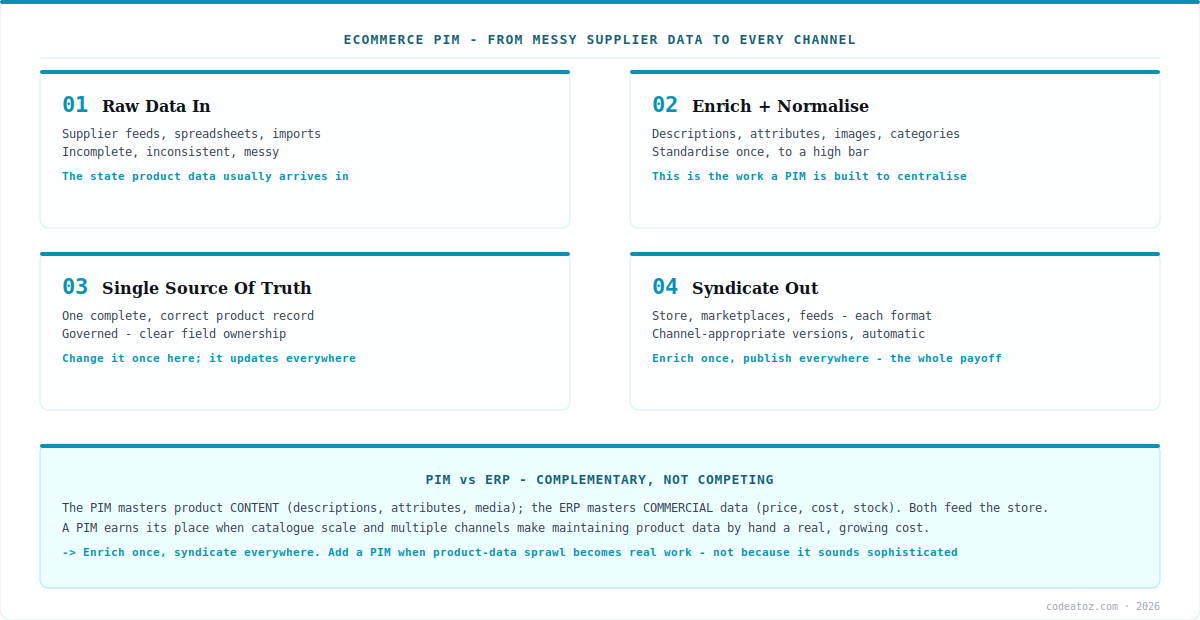
The core idea of an ecommerce PIM is a single source of truth. Instead of product data living independently in your store, your Amazon listings, your Google Shopping feed and a spreadsheet somewhere, it lives once in the PIM, is managed there, and is pushed out (syndicated) to each channel. Change a product description once in the PIM, and it updates everywhere. That single-source model is what an ecommerce PIM provides, and it is the antidote to the inconsistency that creeps in when the same product is maintained in multiple places by multiple people.
Ecommerce PIM: The Problem It Solves
To understand why an ecommerce PIM exists, picture managing product data without one across several channels. Your store has product descriptions. Your marketplace listings need slightly different formats. Your comparison-shopping feeds want specific attributes. A new supplier sends a spreadsheet of 500 products with inconsistent data. Someone has to get all of this correct, consistent and complete across every channel — and every product change means updating multiple places. This does not scale: as catalogue and channels grow, the manual effort and the inconsistency both grow with them.
An ecommerce PIM solves this by centralising the work. Raw supplier data comes into the PIM and is enriched and standardised once. The PIM holds the complete, correct product record. Then it syndicates channel-appropriate versions out to each destination automatically. The payoff is threefold: consistency (every channel shows the same correct data), efficiency (enrich once, not once per channel) and control (a clear place where product data is governed). For a business feeling the pain of product data sprawl, that is exactly what an ecommerce PIM delivers — it turns an unscalable manual mess into a managed pipeline.
Ecommerce PIM vs ERP: Different Jobs
A common confusion is how an ecommerce PIM relates to an ERP, since both hold product-related data. The distinction is one of purpose. An ERP is an operational system — it cares about products as things to stock, cost, sell and account for: SKUs, prices, quantities, order lines. A PIM is a marketing and information system — it cares about products as things to describe and present: rich descriptions, attributes, images, categorisation, the content that helps a product sell. They overlap on the product record but optimise for different jobs.
In a mature setup, an ecommerce PIM and an ERP work together, each mastering what it does best. The ERP typically masters commercial data (price, cost, stock); the PIM masters descriptive data (content, attributes, media). Both feed the storefront, and the integration between them follows the same ownership-and-direction discipline as any ERP integration: decide which system owns each field, and flow data from master to consumer. Understanding that a PIM and ERP are complementary, not competing, clarifies where an ecommerce PIM fits — it is the product-content layer, sitting alongside the ERP’s operational layer, both syndicating into your store and channels.
| Aspect | Ecommerce PIM | ERP |
|---|---|---|
| Primary job | Product information + content | Operations + accounting |
| Masters | Descriptions, attributes, media | Price, cost, stock, orders |
| Optimised for | Enrichment + syndication | Stock, fulfilment, finance |
| Feeds | Store, marketplaces, feeds | Store, fulfilment, accounts |
| You need it when | Many products + channels | Running a real business |
Ecommerce PIM: When You Need One and Getting It Right
Not every store needs an ecommerce PIM, and adding one prematurely is cost and complexity for little gain. The honest signal that you need one is pain: a large or fast-growing catalogue, selling across multiple channels (store plus marketplaces plus feeds), product data that is inconsistent or costly to maintain, and a team spending real time keeping the same product correct in several places. If that describes you, an ecommerce PIM will likely pay for itself. If you have a modest catalogue on a single channel, your store platform’s native product management is probably enough, and a PIM would be over-engineering.
A PIM earns its place when product data sprawl becomes real work. The tipping point for an ecommerce PIM is when maintaining product data across channels consumes meaningful time or produces visible inconsistency. Below that, native product management suffices. The mistake is adding a PIM because it sounds sophisticated, or refusing one while your team drowns in spreadsheet syndication. Match the tool to the actual pain.
Getting an ecommerce PIM right, once you need one, comes down to two things. First, governance: decide who owns which fields and how data flows in (from suppliers) and out (to channels), because a PIM without clear governance just relocates the mess. Second, integration: the PIM must connect cleanly to your store, ERP and channels, following sound API integration practice so the syndication actually works reliably. Done well, an ecommerce PIM becomes the calm centre of your product operation — one place where product data is correct, and everywhere else simply receives it. Our team designs PIM strategies and integrations for stores that have outgrown managing product data by hand.
How we advise on ecommerce PIM
We only recommend a PIM when the pain is real. A PIM is powerful but not free, so we look for the actual signals — catalogue scale, multiple channels, visible inconsistency, time lost to manual syndication — before suggesting one. For a modest single-channel store, native product management is the right answer, and we say so rather than selling complexity.
We treat governance as the make-or-break decision. A PIM without clear field ownership and data-flow rules just becomes a fancier place to store an inconsistent mess. We define who owns each field and how data enters and leaves before implementing, because the governance model is what actually delivers the single source of truth, not the software.
We design the PIM, ERP and store to complement, not compete. The PIM masters product content, the ERP masters commercial data, and both feed the store. We map that ownership explicitly so the three systems reinforce each other — the same integration discipline we apply to any ERP connection, because a PIM is only as good as how cleanly it syndicates.
Frequently Asked Questions About Ecommerce PIM
What is an ecommerce PIM?
A PIM (Product Information Management) system is the single, authoritative home for your product data — descriptions, attributes, images, specifications and categorisation. It exists to manage product content through its lifecycle: enriching raw supplier data once, holding the complete correct record, then syndicating channel-appropriate versions to your store, marketplaces and feeds automatically. Change data once, and it updates everywhere.
What problem does a PIM solve?
Product data sprawl. Without a PIM, the same product is maintained separately in your store, marketplace listings and feeds, so every change means updating multiple places and inconsistency creeps in — and this gets worse as catalogue and channels grow. A PIM centralises product data so you enrich it once and syndicate everywhere, delivering consistency, efficiency and control over what was an unscalable manual mess.
What is the difference between a PIM and an ERP?
Different jobs. An ERP is operational — it handles products as things to stock, cost, sell and account for (SKUs, prices, quantities, orders). A PIM is informational — it handles products as things to describe and present (rich content, attributes, images, categorisation). They overlap on the product record but optimise differently, and in a mature setup they work together, each mastering what it does best.
Do I need a PIM for my ecommerce store?
Only if you feel the pain: a large or fast-growing catalogue, selling across multiple channels, product data that is inconsistent or costly to maintain, and a team spending real time keeping products correct in several places. If that is you, a PIM likely pays for itself. With a modest catalogue on a single channel, your store’s native product management is probably enough, and a PIM would be over-engineering.
Can a PIM and ERP work together?
Yes, and in a mature setup they should. The ERP typically masters commercial data (price, cost, stock) and the PIM masters descriptive data (content, attributes, media), with both feeding the storefront. The integration between them follows the same ownership-and-direction discipline as any ERP integration: decide which system owns each field, and flow data from master to consumer. They are complementary, not competing.
What makes a PIM implementation succeed?
Two things. Governance: clear rules for who owns which fields and how data flows in from suppliers and out to channels — without this a PIM just relocates the mess. And integration: the PIM must connect cleanly to your store, ERP and channels following sound API practice so syndication works reliably. Get governance and integration right, and the PIM becomes a genuine single source of truth.
Drowning in Product Data?
Our team designs PIM strategies and integrations so product data lives in one place and syndicates everywhere, cleanly.