
Node.js vs PHP in 2026 — Honest Comparison for E-Commerce Developers
No hype. Which runtime actually wins for e-commerce backends, headless stores, and custom APIs in 2026?
The Node.js vs PHP debate resurfaces every year, and every year the answer is the same: it depends on the project. But that answer is more nuanced in 2026 than it was in 2018. PHP 8.3’s JIT compiler, fibers, and readonly classes have closed many of the performance gaps. Node.js 22 LTS brings native ESM, a built-in test runner, and near-browser API parity. This honest Node.js vs PHP comparison looks at 12 criteria that matter for e-commerce developers building stores, APIs, and headless backends.
We work with both daily — PHP for WooCommerce, Magento 2, and WordPress plugins; Node.js for headless storefronts, REST API proxies, and real-time features. Here’s what we’ve actually observed in production.
Performance: Node.js vs PHP in 2026
PHP 8’s JIT compiler significantly reduced the performance gap that existed in PHP 7 days. For typical e-commerce workloads — rendering product pages, processing orders, running database queries — the difference is negligible on properly configured servers.
- Node.js wins for I/O-heavy operations — the event loop excels when waiting on many simultaneous database queries, external API calls, or file reads
- PHP wins for CPU-intensive operations — image processing, PDF generation, and complex data transformations are simpler to parallelise in PHP with worker processes
- In practice — neither is a bottleneck for typical WooCommerce or Magento workloads. Your database is almost always the bottleneck, not the runtime
E-Commerce Framework Ecosystem: Node.js vs PHP
This is the most decisive factor for most projects, and PHP wins overwhelmingly for traditional e-commerce:
- PHP ecosystem: WooCommerce, Magento 2, Shopware, Sylius — all mature, thousands of plugins, huge talent pool
- Node.js ecosystem: Medusa.js, Commerce.js, Vendure — younger, API-first, designed for headless. Excellent for custom builds
- If you need headless: Node.js (Next.js, Nuxt) shines as the frontend layer; PHP still powers the backend in many production headless setups
Developer Experience in 2026
PHP 8.3 has dramatically improved developer experience: constructor property promotion, readonly properties, fibers for async, named arguments, union types, and first-class callable syntax all make PHP more readable and maintainable. The language is no longer the PHP 5 developers remember.
Node.js 22 now ships with a native test runner, a built-in watch mode, and near-browser API parity (fetch, WebStreams, crypto). TypeScript support via --experimental-strip-types arrived without a build step. The tooling story is cleaner than it was three years ago.
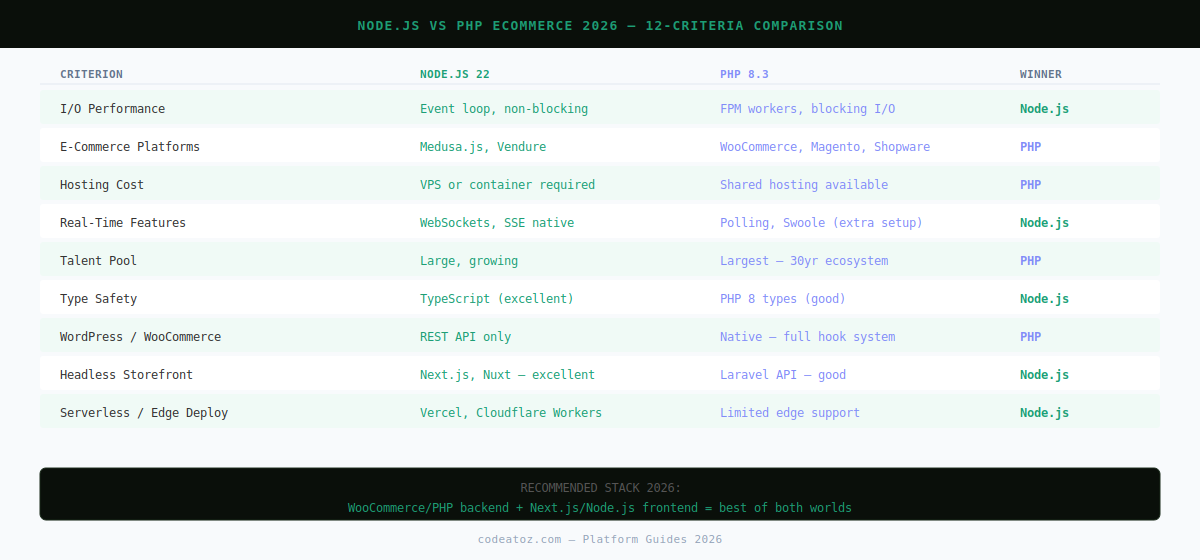
The 12-Criteria Node.js vs PHP Verdict
COMPARISON TABLE — E-COMMERCE CONTEXT
When to Choose PHP for E-Commerce in 2026
- You’re building on or extending WooCommerce, Magento 2, or Shopware
- Your team already has PHP expertise and the project deadline is tight
- Hosting budget is constrained — shared PHP hosting is still the cheapest option
- You need extensive plugin/extension support without building everything from scratch
- The project involves heavy CMS content management alongside e-commerce
When to Choose Node.js for E-Commerce in 2026
- You’re building a headless storefront with React or Vue consuming a WooCommerce or Medusa backend
- Real-time features matter — live inventory updates, auction bidding, live chat, or push notifications
- Your team is TypeScript-first and wants a unified language across frontend and backend
- You’re building a greenfield API-first commerce platform with Medusa.js or Vendure
- Serverless/edge deployment is a requirement (Vercel Functions, Cloudflare Workers)
At CodeAtoZ, we use PHP for WooCommerce and Magento 2 builds (because the ecosystems demand it), and Node.js for headless storefronts, API proxies, and real-time features. They’re complementary tools, not competitors — and most modern e-commerce projects use both.
For hands-on examples of both in an e-commerce context, see our guides on WooCommerce custom REST API endpoints in PHP and building a headless WooCommerce store with React and Node.js. The Node.js 22 release notes cover what’s new in the latest LTS.
Frequently Asked Questions — Node.js vs PHP for E-Commerce
Is Node.js faster than PHP for e-commerce in 2026?
For I/O-bound workloads like concurrent API calls and database queries, Node.js typically has an edge due to its non-blocking event loop. For CPU-bound tasks, PHP 8.3 with JIT is competitive. In real e-commerce applications, the database is almost always the bottleneck — not the runtime. Neither language is meaningfully faster for typical store page loads.
Can I use Node.js with WooCommerce?
Yes — Node.js can communicate with WooCommerce via the REST API. Many headless WooCommerce setups use Node.js (typically Next.js or Express) as the frontend layer or API proxy, with WooCommerce handling the commerce backend in PHP. You’d use Node.js for the storefront and WooCommerce REST API calls, not to replace PHP itself.
Should I learn PHP or Node.js for e-commerce development in 2026?
Learn PHP if you want to work with WooCommerce, Magento 2, or Shopware — these platforms power the majority of the world’s e-commerce sites and demand PHP expertise. Learn Node.js if you want to build headless storefronts, real-time features, or API-first platforms like Medusa.js. Ideally, learn both — they’re complementary in modern e-commerce stacks.
What is the Node.js equivalent of WooCommerce?
Medusa.js is the most mature Node.js e-commerce platform in 2026 — open source, TypeScript-first, headless by design, with modules for cart, checkout, products, and payments. Vendure is another strong option, particularly for B2B. Neither has the plugin ecosystem depth of WooCommerce yet, so custom feature development requires more from-scratch work.
Is PHP dying in 2026?
No — PHP is not dying. PHP 8.3 is a modern, well-maintained language. WordPress powers over 40% of the web and WooCommerce has roughly 30% of the e-commerce market. Magento (Adobe Commerce) dominates the enterprise segment. PHP’s death has been predicted since 2014; the language has actually improved dramatically in the last six years.
What does a typical Node.js vs PHP e-commerce stack look like in 2026?
A common pattern we see: WooCommerce/PHP on the backend for product management, orders, and payments — with a Next.js/Node.js frontend consuming the WooCommerce REST API. PHP handles commerce logic and admin; Node.js handles the customer-facing storefront. It’s not Node.js OR PHP — it’s both, for different responsibilities.
Need Help Choosing the Right Stack?
CodeAtoZ builds e-commerce projects in both PHP and Node.js — and can advise on the right architecture for your specific requirements. No agenda, just honest recommendations.




