
How Much Does an Ecommerce Website Cost in 2026?
Ecommerce website cost is a range, not a number — and the range is wide. What you pay depends on the platform tier, how custom the build is, and how many systems it integrates with. Here is the honest picture.
Ecommerce website cost is the question every merchant asks first and every honest developer answers with “it depends” — not to be evasive, but because a single figure would be a lie. The ecommerce website cost range spans from a modest template store to a six-figure-plus enterprise build, and where your project lands depends on three things: the platform tier you choose, how custom the build is, and how many systems it must integrate with. This guide explains the ranges and what moves them, so “it depends” becomes something you can actually plan around.
Search intent: informational/budgeting — merchants and business owners planning an ecommerce build budget. We cover why cost is a range, the broad tiers, what moves the number most, ongoing cost, and how to get a real quote. It builds on our Magento development cost guide and project scoping guide.
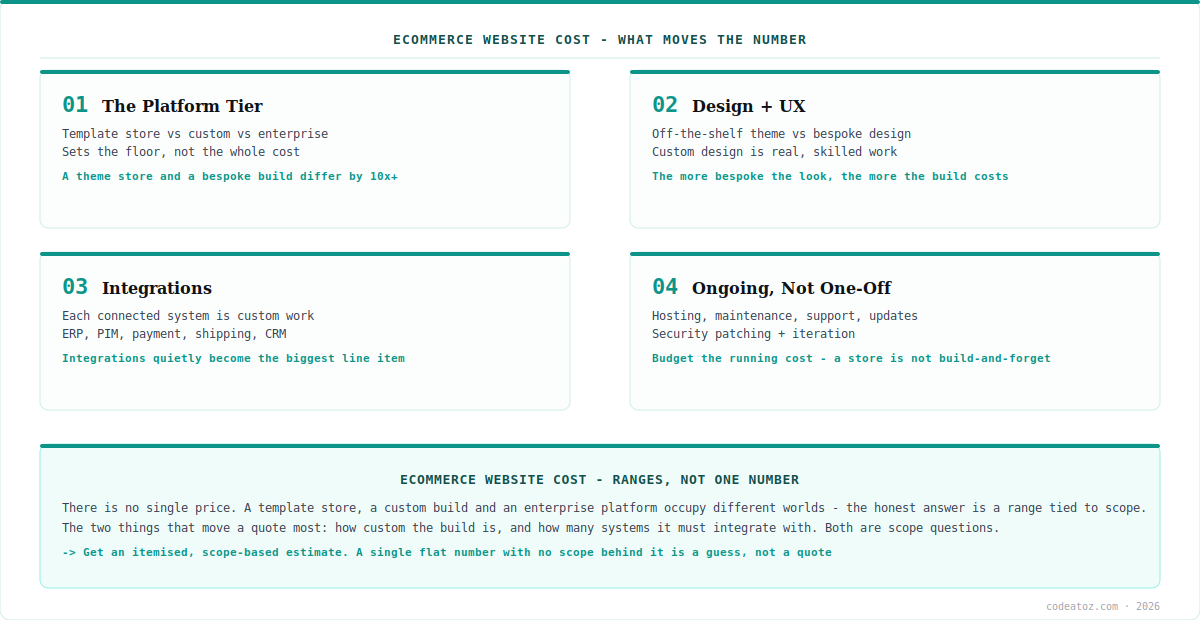
Ecommerce Website Cost: Why It Is a Range, Not a Number
The reason ecommerce website cost cannot be a single number is that “an ecommerce website” describes wildly different things. A small business selling a handful of products on a ready-made theme, and a large retailer with a custom-designed store, complex catalogue, B2B pricing and integrations to an ERP and warehouse system, are both “ecommerce websites” — and their costs differ by an order of magnitude or more. Quoting one number for both is meaningless.
So the useful framing is a range tied to scope. The ecommerce website cost you should expect depends on where your project sits on a spectrum from “standard store on existing tools” to “bespoke enterprise build”. The more custom the design, the more custom the functionality, and the more systems involved, the higher the cost — predictably and for good reasons. Understanding that spectrum lets you place your project on it and form a realistic budget expectation, rather than fixating on a headline figure that was never going to apply to you.
Ecommerce Website Cost: The Broad Tiers
Broadly, ecommerce website cost falls into recognisable tiers. At the entry level, a store built on a ready-made theme on a SaaS platform or WooCommerce, with standard functionality and minimal customisation, is the most affordable — you are largely configuring existing tools rather than building. In the middle sits the custom build: a bespoke or heavily customised design, some custom functionality, a few integrations — the tier most serious independent stores occupy. At the top is the enterprise build: fully bespoke design, extensive custom development, complex integrations and a platform like Magento or Shopify Plus, where ecommerce website cost reaches its highest ranges.
| Tier | What you get | Relative cost |
|---|---|---|
| Template store | Ready theme, standard features, minimal custom | Lowest |
| Custom build | Bespoke design, some custom features, a few integrations | Mid |
| Enterprise build | Fully bespoke, extensive custom, complex integrations | Highest |
These tiers are about the nature of the work, not just the price, and they are why the ecommerce website cost question needs a conversation about requirements before any number. A merchant expecting a template-store price for an enterprise-build brief will be shocked; one budgeting an enterprise figure for a template store is overspending. Placing your requirements in the right tier is the first step to a realistic budget.
Ecommerce Website Cost: What Moves the Number Most
Within any tier, two factors move ecommerce website cost more than any other. The first is how custom the build is. A store using an existing theme and standard platform features is largely configuration; a store with bespoke design and custom functionality is genuine build work, and the gap between them is large. Every bespoke element — a custom checkout flow, a unique product configurator, a tailored design — is skilled work that adds cost, and it adds up.
The second, and the one most often underestimated, is integrations. Every system your store connects to — ERP, PIM, payment gateways, shipping, tax, CRM, email marketing — is custom integration work, and integrations quietly become one of the largest lines in ecommerce website cost because merchants think of them as things they “have” rather than things that must be built. A store needing a dozen integrations costs substantially more than a comparable store needing two. When budgeting ecommerce website cost, inventory every system you need to connect — that list moves the number as much as anything else.
The two questions that most change your quote: how bespoke, and how many integrations? Before you can get a meaningful ecommerce website cost figure, you need answers to those two. A ready theme with two integrations and a fully bespoke design with a dozen integrations are different projects at different prices, even on the same platform. Both are scope questions — which is why an honest quote always starts with scoping, not a price.
Ecommerce Website Cost: Ongoing Cost and Getting a Real Quote
One more thing the ecommerce website cost question routinely omits: a store is not build-and-forget. Beyond the build, budget for ongoing costs — hosting, maintenance, security updates, and the iteration every living store needs. On self-hosted platforms these are significant (as our Magento cost guide details); even on SaaS there are platform fees and app subscriptions. A build budget without a running budget underestimates the true ecommerce website cost and leaves stores unmaintained.
To get a real quote, provide real scope. The more precisely you can describe what you need — platform, design ambition, specific features, the list of integrations, whether you are migrating data — the more accurate the ecommerce website cost estimate you will receive. A vague brief gets a vague, padded, or unreliable number; a scoped brief gets an itemised, defensible one, as our project scoping guide explains. Be wary of any firm quoting a confident ecommerce website cost before understanding your requirements — that number is a sales tactic, not an estimate. Our team scopes properly and quotes itemised, so the figure means something.
How we answer “what does an ecommerce website cost?”
We answer with questions, not a number. A figure given before we understand the brief would mislead — too high for a simple store, too low for a complex one. We ask about platform, design, features and integrations first, because the honest ecommerce website cost follows from scope, and a blind number helps nobody.
Integrations are the line clients most underestimate. Merchants picture the storefront and forget that every connection to an ERP, payment gateway or shipping system is custom work. We inventory integrations early, because that list often moves a quote as much as the design and build combined, and surfacing it late is how budgets get blown.
We insist clients budget the running cost too. The build is the visible number; hosting, maintenance and iteration are the ongoing one. We present both, because a store funded to launch but not to run becomes a security and performance liability — and the true ecommerce website cost is always build plus run, never build alone.
Frequently Asked Questions About Ecommerce Website Cost
How much does an ecommerce website cost?
It is a wide range, not a single figure. A template store on a ready theme is the most affordable; a custom build with bespoke design and some integrations sits in the middle; a fully bespoke enterprise build reaches the highest ranges. Where you land depends on the platform tier, how custom the build is, and how many integrations you need — all scope questions.
Why can’t anyone give me a fixed ecommerce website cost?
Because “an ecommerce website” describes wildly different projects. A small store on a ready theme and a bespoke enterprise build with complex integrations differ in cost by an order of magnitude, yet both are ecommerce websites. A fixed number given before understanding your requirements would be a guess. A real figure requires scoping the actual work first.
What increases ecommerce website cost the most?
Two things: how custom the build is, and how many integrations it needs. Bespoke design and custom functionality are genuine build work far beyond configuring a theme. And every connected system — ERP, payment, shipping, CRM — is custom integration work that quietly becomes one of the largest lines. Both are the questions that most move a quote.
Does ecommerce website cost include ongoing fees?
The build cost usually does not — but you should budget ongoing costs separately: hosting, maintenance, security updates and iteration. On self-hosted platforms these are significant; even on SaaS there are platform fees and app subscriptions. A store is not build-and-forget, so the true cost is always build plus run, and a budget covering only the build is incomplete.
How do I get an accurate ecommerce website quote?
Provide real scope: the platform, your design ambition, the specific features you need, a list of every integration, and whether you are migrating data. The more precisely you describe requirements, the more accurate and itemised the quote. A vague brief gets a vague or padded number; a scoped brief gets a defensible one you can plan around.
Should I be suspicious of a very cheap or instant quote?
Be cautious of a confident, fixed ecommerce website cost given before anyone understands your requirements — that is a sales tactic, not an estimate, and often precedes either a padded final bill or a store that cuts corners. A trustworthy quote follows a scoping conversation and itemises the work. Cheap headline numbers frequently omit integrations, ongoing costs or quality.
Want a Real Ecommerce Website Quote?
Our team scopes your requirements properly and quotes itemised — so the number reflects your actual project, not a guess.




