
The Complete Shopify Checkout Extensibility Guide 2026
Shopify checkout extensibility is the modern, upgrade-safe way to customise checkout — UI extensions, Shopify Functions, the Branding API and Web Pixels, off checkout.liquid.
Shopify checkout extensibility is the modern framework for customising Shopify’s checkout — replacing the old, fragile checkout.liquid approach with sandboxed UI extensions, Shopify Functions, a Branding API and Web Pixels. The point of Shopify checkout extensibility is upgrade-safe customisation: changes that survive Shopify’s platform updates instead of breaking, which is exactly what checkout.liquid customisations could not guarantee. This guide covers each piece and the migration.
Search intent: informational/procedural — developers and merchants customising Shopify checkout and migrating off checkout.liquid. We cover why extensibility replaced liquid, UI extensions, Functions, the Branding API, Web Pixels, the migration, and the Plus relationship. It builds on our Shopify Functions guide and connects to Plus vs Standard.
Shopify Checkout Extensibility: Why It Replaced checkout.liquid
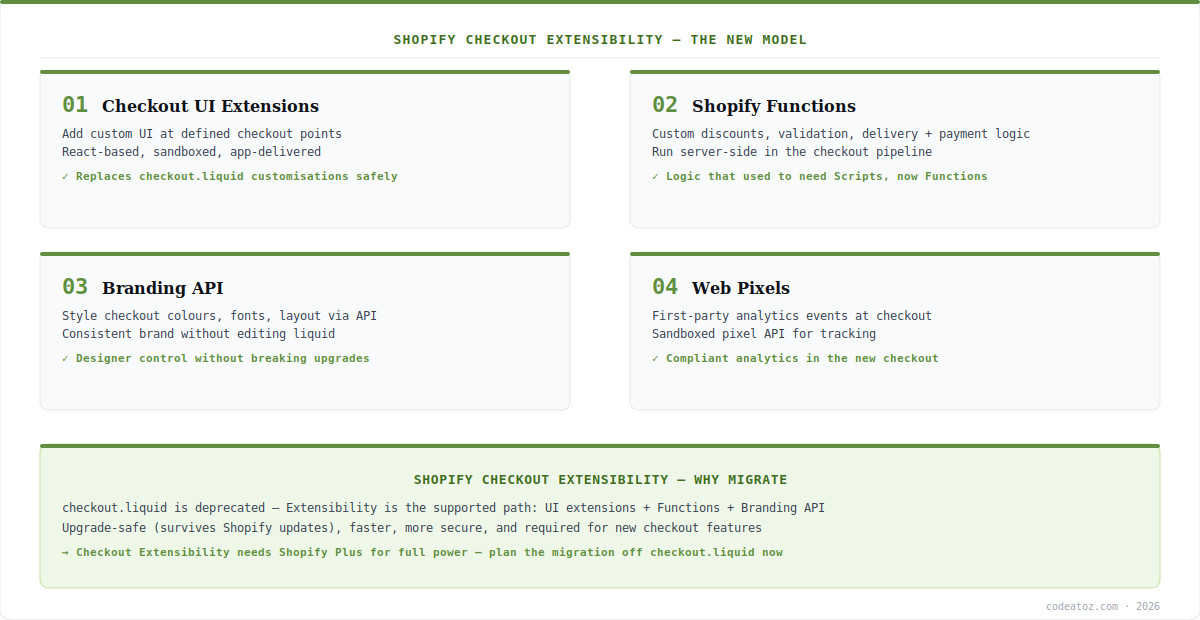
For years, deep checkout customisation on Shopify meant editing checkout.liquid — powerful but fragile, because custom liquid could break on platform updates and was a security and maintenance liability. Shopify checkout extensibility exists to fix this: it provides defined, sandboxed extension points so customisations are upgrade-safe, more secure, and faster (the Shopify checkout overview frames the model). checkout.liquid is now deprecated (per Shopify’s notice), and Shopify checkout extensibility is the supported, required path forward — new checkout features ship only on the extensibility model. Migrating is not optional for merchants who customised checkout the old way.
Shopify Checkout Extensibility: UI Extensions, Functions and Branding
Shopify checkout extensibility has four pillars. Checkout UI extensions add custom interface elements at defined checkout points — React-based, sandboxed, delivered by apps (custom fields, upsells, trust badges, delivery instructions). Shopify Functions run custom server-side logic in the checkout pipeline — discounts, validation, delivery and payment customisation — replacing what Shopify Scripts used to do. The Branding API styles checkout (colours, fonts, layout) consistently via API rather than liquid edits, giving designers control without breaking upgrades. And Web Pixels provide sandboxed, first-party analytics events at checkout. Together these make Shopify checkout extensibility cover everything checkout.liquid did, but safely. The checkout extensibility documentation details each.
| Pillar | Purpose | Replaces |
|---|---|---|
| UI Extensions | Custom UI at checkout points | checkout.liquid UI edits |
| Functions | Discounts, validation, delivery logic | Shopify Scripts |
| Branding API | Checkout styling via API | liquid style edits |
| Web Pixels | First-party checkout analytics | liquid tracking snippets |
Shopify Checkout Extensibility: Migration and Plus
If your store still runs checkout.liquid customisations, the Shopify checkout extensibility migration is now a priority — map each existing customisation to its new home (UI edits → UI extensions, Scripts → Functions, styling → Branding API, tracking → Web Pixels) and rebuild on the supported model before deprecation forces it. On the Plus relationship: the full power of Shopify checkout extensibility — especially extensive checkout UI customisation — is a Shopify Plus capability, with standard plans more limited. So planning a Shopify checkout extensibility migration may intersect with a Plus decision. Either way, the direction is fixed: checkout.liquid is going away, and extensibility is the future of Shopify checkout. Our Shopify team runs these migrations and builds checkout extensions.
What we have learned migrating to checkout extensibility
Map before you build. The clean migration starts by cataloguing every existing checkout.liquid customisation and assigning each to its new pillar — UI extension, Function, Branding API or Web Pixel. Teams that rebuild ad hoc miss customisations; the mapping exercise catches everything.
Functions replacing Scripts is the trickiest part. Logic that lived in Shopify Scripts has to be re-expressed as Functions, which run differently. We budget the most migration time here, because discount and validation logic is where subtle behaviour changes hide.
The upgrade-safety payoff is real. The whole point of checkout extensibility is that customisations survive Shopify updates. After migrating clients off checkout.liquid, the recurring “an update broke our checkout” incidents simply stop — that reliability is the strongest argument for moving promptly.
Frequently Asked Questions About Shopify Checkout Extensibility
What is Shopify checkout extensibility?
Shopify checkout extensibility is the modern framework for customising Shopify checkout, replacing the old checkout.liquid approach. It comprises UI extensions, Shopify Functions, the Branding API and Web Pixels — sandboxed, upgrade-safe extension points so customisations survive Shopify’s platform updates instead of breaking.
Why did Shopify replace checkout.liquid?
checkout.liquid allowed powerful customisation but was fragile — custom code could break on platform updates and posed security and maintenance risks. Shopify checkout extensibility replaces it with defined, sandboxed extension points that are upgrade-safe, more secure and faster. checkout.liquid is now deprecated and extensibility is the supported path.
What are checkout UI extensions?
Checkout UI extensions are one pillar of Shopify checkout extensibility — React-based, sandboxed interface elements added at defined checkout points, delivered by apps. They enable custom fields, upsells, trust badges, delivery instructions and more, replacing the UI customisations that previously required editing checkout.liquid.
How do Shopify Functions relate to checkout extensibility?
Shopify Functions are the logic pillar of checkout extensibility — running custom server-side logic in the checkout pipeline for discounts, validation, and delivery or payment customisation. They replace Shopify Scripts, letting you express checkout business logic in an upgrade-safe, supported way within the extensibility model.
Do I need Shopify Plus for checkout extensibility?
The full power of checkout extensibility, especially extensive checkout UI customisation, is a Shopify Plus capability, with standard plans more limited. Some extensibility features are broadly available, but deep checkout customisation typically requires Plus — so a checkout extensibility migration may intersect with a Shopify Plus decision.
How do I migrate from checkout.liquid to checkout extensibility?
Catalogue every existing checkout.liquid customisation and map each to its new home — UI edits to UI extensions, Scripts to Functions, styling to the Branding API, tracking to Web Pixels — then rebuild on the supported model. Since checkout.liquid is deprecated, plan this Shopify checkout extensibility migration before deprecation forces it.
Migrating to Checkout Extensibility?
Our team maps and rebuilds checkout.liquid customisations on extensibility — UI extensions, Functions, Branding API.




