WooCommerce AI search optimization: Getting Cited by ChatGPT & AI Search
Shoppers increasingly ask AI what to buy. If ChatGPT, Gemini and Perplexity can’t read your store, they can’t recommend it.
A growing share of product research now starts inside an AI assistant: “best waterproof boots under £150?” and the answer names specific products. That channel — WooCommerce AI search optimization, or Answer Engine Optimisation (AEO) — rewards stores an AI can actually read, and ignores the rest. This guide covers what it takes, honestly, including where the hype outruns reality.
First, the honest calibration: for most stores today, classic Google search and paid ads still drive far more revenue than AI answers do. AI-assisted shopping is growing fast but it’s not yet the main channel. The reason to act now isn’t that it’s huge — it’s that it’s cheap to get ready, compounding, and most competitors haven’t. WooCommerce AI search optimization is a low-cost early bet, not a magic revenue switch.
The Shift: From Blue Links to AI Answers
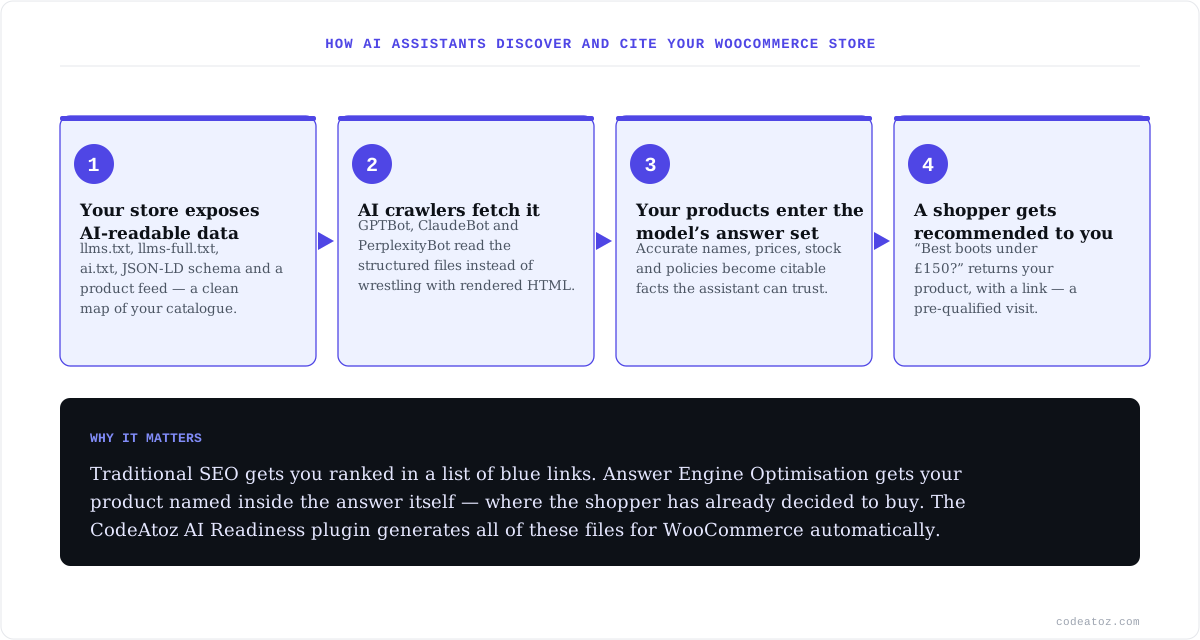
Traditional SEO gets you into a list of ten blue links the shopper still has to sift through. AI answers collapse that: the assistant reads the web, then states a recommendation. Your product is either named in that answer, with a link, or it isn’t there at all. There’s no page two.
- Zero-click decisions. The shopper often decides inside the answer, before visiting any site — so being cited is the whole game.
- Pre-qualified clicks. When they do click through from an AI recommendation, intent is high; the assistant already matched them to you.
- Winner-takes-more. Assistants tend to name a short list, not a page of results, so the gap between cited and uncited is wider than in classic search.
This is why WooCommerce AI search optimization matters even while the channel is still emerging: the cost of being ready is low, and the stores that prepare early are the ones models learn to trust. Our WooCommerce AI readiness overview covers the broader picture; this post focuses on the search-visibility side.
What WooCommerce AI Search Optimization Actually Requires
Making a store citable isn’t about tricking a model — it’s about handing it clean, structured facts it can trust. Four things do most of the work:
| Signal | What it gives the AI | Why it matters |
|---|---|---|
| llms.txt / llms-full.txt | A plain-text map of your catalogue and policies | Models read it in one request instead of rendering heavy HTML |
| JSON-LD Product schema | Structured price, stock, rating, brand | Machine-readable facts the assistant can quote with confidence |
| Product feed (JSON/CSV) | A complete, exportable catalogue | Clean data for AI shopping surfaces and your own pipelines |
| Readiness score | A per-product audit of what’s missing | Tells you which products aren’t AI-ready yet, and why |
The Schema.org Product vocabulary and Google’s product structured-data guidance are the foundation for the schema piece, and the llms.txt standard defines the plain-text map. Doing all of this by hand on a live WooCommerce catalogue is the hard part — which is where tooling earns its place.
WooCommerce AI Search Optimization: Making Your Store Citable
The practical route for WooCommerce AI search optimization is to generate those signals automatically and keep them fresh. The free CodeAtoz AI Readiness for WooCommerce plugin does exactly this, without sending your data to any external API:
- Readiness Score per product with actionable tips on what’s missing (thin descriptions, no schema, missing attributes).
- llms.txt, llms-full.txt and ai.txt generated from your real catalogue, synced with Yoast, RankMath or AIOSEO.
- JSON-LD schema auto-injection on product pages, so every product ships machine-readable facts.
- Product feed export in JSON (OpenAI spec) and CSV for AI surfaces and your own use.
- Bulk Fix that groups products by issue type so you’re not editing them one by one.
Being AI-readable gets you into consideration; it doesn’t guarantee a citation. Models still weigh relevance, price, reviews and reputation. Think of WooCommerce AI search optimization as removing the technical barriers that keep you out of the running — necessary, not sufficient. Good products and genuine reviews still do the rest.
Measuring Whether AI Is Actually Reading Your Store
You can’t improve what you can’t see. The useful signal here is crawler activity: are the AI bots actually fetching your content?
- Bot Traffic Dashboard — shows visits from GPTBot, ClaudeBot, PerplexityBot and others, so you know the files are being read.
- Auto-Scheduler — cron-based re-scans and llms.txt regeneration so your map never goes stale as the catalogue changes.
- Email Digest — a weekly readiness-score summary, so AEO doesn’t fall off your radar.
For the crawler side of the decision — which bots to allow in the first place — see our companion piece on WooCommerce AI crawlers. And for the file that does the heavy lifting, WooCommerce llms.txt goes deep on the format.
Your WooCommerce AI Search Optimization Checklist
- Audit every product’s readiness score and clear the flagged issues
- Generate llms.txt and llms-full.txt from your live catalogue
- Confirm JSON-LD Product schema is injected on all product pages
- Export a product feed (JSON/CSV) for AI surfaces
- Write genuine descriptions and Q&A — thin content won’t get cited
- Enable the auto-scheduler so files stay fresh
- Watch the bot dashboard to confirm AI crawlers are fetching your content
- Keep expectations calibrated — this is an early, compounding bet, not instant sales
Want your store made AI-citable without the manual slog? Our WooCommerce team sets up the full WooCommerce AI search optimization stack — readiness fixes, llms.txt, schema and monitoring — and we’re honest with you about what to expect from the channel. See also our Claude WordPress connector work for how we wire AI into WordPress more broadly.
Frequently Asked Questions
What is WooCommerce AI search optimization?
It’s preparing your WooCommerce store so AI assistants — ChatGPT, Google Gemini, Microsoft Copilot and Perplexity — can read, trust and cite your products in their answers. Also called Answer Engine Optimisation (AEO), it relies on AI-readable files like llms.txt, structured JSON-LD schema and a clean product feed, rather than classic keyword SEO alone.
Is AI search actually driving sales yet, or is it hype?
Honestly, for most stores it’s still a smaller channel than Google search and paid ads — but it’s growing quickly. The case for acting now isn’t that it’s already huge; it’s that getting ready is cheap, the benefit compounds as models re-crawl, and most competitors haven’t done it. Treat it as a low-cost early bet, not a revenue switch.
How do I get my WooCommerce products recommended by ChatGPT?
Make your catalogue machine-readable and trustworthy: publish an llms.txt map, inject JSON-LD Product schema, expose a product feed, and write genuine descriptions and reviews. The CodeAtoz AI Readiness plugin generates these automatically. Being readable gets you into consideration — relevance, price and reputation still decide whether you’re the one named.
Does AI search optimization need external APIs or send my data away?
The CodeAtoz AI Readiness plugin generates llms.txt, schema and feeds locally, without calling external APIs or shipping your product data to a third party. That keeps your catalogue on your own site and avoids per-call costs. The AI assistants then read the public files you’ve published, just as a search crawler reads your pages.
Is being AI-readable enough to get cited in AI answers?
No — it’s necessary but not sufficient. AI-readable files remove the technical barriers that keep you out of the running, but models still weigh relevance, pricing, ratings and reputation when choosing what to recommend. Think of it as qualifying to compete; good products, genuine reviews and fair prices still do the final work.
How do I know if AI crawlers are reading my store?
Watch your crawler traffic. The plugin’s Bot Traffic Dashboard reports visits from GPTBot, ClaudeBot, PerplexityBot and other AI agents, so you can confirm your llms.txt and product pages are actually being fetched. Pair that with the auto-scheduler so your files regenerate as your catalogue changes and never serve stale data to the models.
Want your WooCommerce store ready for AI search?
We’ll audit your catalogue, generate llms.txt and schema, export your feed, and set up crawler monitoring — with honest expectations about what the AI channel can do for your store in 2026.