
Punchout Catalog and EDI — How Enterprise B2B Buyers Actually Purchase
A punchout catalog and EDI are how large buyers purchase through their own procurement systems. If your store can’t support them, you may not make the approved-supplier shortlist at all.
A punchout catalog is one of those B2B capabilities that consumer-focused merchants have never heard of and enterprise-focused ones cannot live without. It exists because large organisations do not buy the way individuals do: they purchase through procurement systems like SAP Ariba, Coupa or Oracle Procurement, and they expect to reach your catalogue from inside those systems. A punchout catalog, paired with EDI for order documents, is how you connect your store to enterprise procurement — and for many B2B sellers, it is the capability that decides whether you win the account at all.
Search intent: informational/technical — B2B merchants and developers evaluating procurement integration. We cover why punchout and EDI matter, how a punchout catalog works, what EDI adds, the integration reality, and how to approach it. It builds on our B2B ecommerce platform guide and Magento B2B setup guide.
Punchout Catalog: Why Enterprise B2B Needs It
To understand why a punchout catalog matters, you have to understand how enterprise procurement works. Large organisations centralise purchasing through procurement software to control spend, enforce approvals and maintain audit trails. Their buyers do not browse individual supplier websites and check out with a credit card — they work inside their procurement system, and they expect suppliers to integrate with it. A supplier who cannot integrate is, from the procurement team’s perspective, difficult to buy from.
This is the commercial reality that makes a punchout catalog strategically important: for many enterprise buyers, procurement integration is a requirement to be an approved supplier, not a nice-to-have. If a competitor supports punchout and you do not, the competitor is easier to buy from and wins the business, regardless of who has the better product or price. A punchout catalog is therefore less a technical feature than a commercial gateway to enterprise accounts.
Punchout Catalog: How the Flow Actually Works
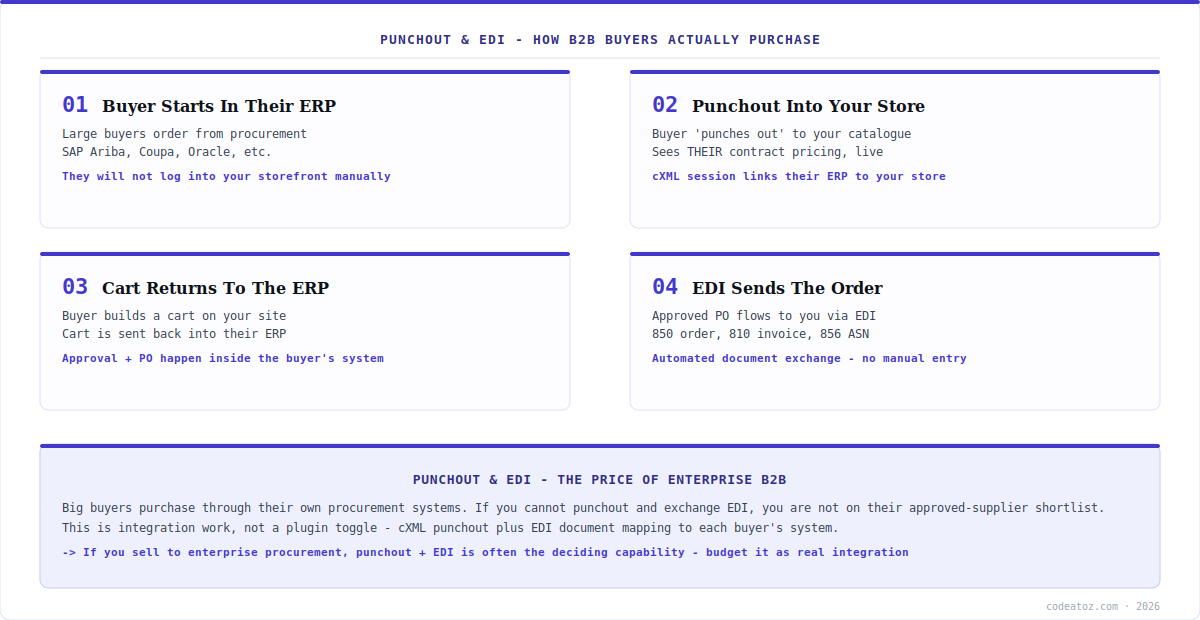
A punchout catalog works by connecting the buyer’s procurement system to your store through a defined handshake, usually the cXML protocol. The buyer, inside their procurement software, selects your catalogue and “punches out” — the procurement system opens a session into your store, passing credentials that identify the buyer’s organisation. Crucially, because the buyer is identified, your store can show their contract pricing, not generic list prices.
The buyer then browses and builds a cart on your store as normal, using your live catalogue, search and product data. But instead of checking out, they return the cart to their procurement system — the punchout catalog session sends the cart contents back into their ERP. There, the purchase goes through the buyer’s own approval workflow and becomes a purchase order. The elegance of the model is that the buyer gets your rich catalogue experience while staying inside their controlled procurement process. Your store provides the catalogue and pricing; their system handles approval and ordering. That division is the whole point of a punchout catalog.
Punchout Catalog and EDI: Completing the Loop
A punchout catalog gets the buyer from their procurement system to your catalogue and back with a cart. EDI (Electronic Data Interchange) completes the loop by handling the order documents that follow. Once the buyer’s approval process turns the returned cart into a purchase order, that PO needs to reach you — and EDI is the standardised, automated way it does, without anyone re-keying it.
EDI defines standard document formats for the B2B transaction: the purchase order (EDI 850), the invoice (EDI 810), the advance shipping notice (EDI 856) and others. These flow automatically between the buyer’s system and yours, so an order approved in the buyer’s procurement software arrives in your system as structured data ready to fulfil, and your invoice returns the same way. Together, a punchout catalog and EDI create a fully integrated purchasing loop: the buyer discovers and carts on your store, approves in their system, and the order and financial documents exchange automatically via EDI. For high-volume enterprise relationships, this automation is not a luxury — manual order entry at scale is error-prone and slow.
| Piece | What it does | Where it runs |
|---|---|---|
| Punchout (cXML) | Buyer reaches your catalogue from their ERP | Session between systems |
| Contract pricing | Buyer sees their negotiated rates | Your store |
| Cart return | Cart goes back to buyer’s procurement | Buyer’s ERP |
| EDI 850 | Purchase order to you | Automated exchange |
| EDI 810 | Invoice back to buyer | Automated exchange |
| EDI 856 | Advance shipping notice | Automated exchange |
This is integration work, not a plugin toggle. A punchout catalog and EDI are real integrations — cXML session handling, buyer identification and contract-price mapping for punchout, and document mapping to each buyer’s specific EDI requirements. Different buyers use different procurement systems with their own quirks, so this is bespoke integration effort, not a switch you flip. Budget it as such, and treat it as the serious capability it is.
Punchout Catalog: Getting It Right
Approaching a punchout catalog and EDI well starts with recognising it as strategic integration, not a feature to rush. First, confirm the demand: do your enterprise buyers actually require punchout and EDI, or is this speculative? If real accounts are asking, it is worth serious investment; if not, it may be premature. The requirement usually comes directly from the buyer’s procurement team, who will specify what they need.
Then treat it as integration work with the right platform foundation. A native B2B platform like Adobe Commerce provides the account and pricing structures a punchout catalog depends on, and supports the integration; bolt-on setups need custom development to reach the same place. Expect to work with each buyer’s specific procurement system and EDI requirements rather than a one-size solution. Done properly, a punchout catalog and EDI turn you into an easy-to-buy-from supplier that enterprise procurement teams favour — which is exactly the commercial payoff that justifies the integration effort. Our team builds punchout and EDI integrations for B2B stores selling into enterprise procurement.
What we have learned building punchout and EDI
The requirement almost always comes from the buyer, not the seller. Merchants rarely wake up wanting punchout; they discover they need it when a large prospect’s procurement team says “we buy via Ariba, can you punchout?”. We treat a real buyer request as the signal to invest, because that means an actual account is on the line.
Every buyer’s setup is a little different. Punchout and EDI are standards, but each procurement system and each buyer implement them with their own quirks and required document fields. We scope per-buyer rather than assuming one integration serves all, because that assumption is where these projects go over budget.
The platform’s B2B foundation makes or breaks it. Punchout depends on showing the right buyer their contract pricing, which needs solid account and pricing structures underneath. On a native B2B platform that foundation exists; on a bolt-on setup we often have to build it first. We assess that foundation before quoting the integration.
Frequently Asked Questions About Punchout and EDI
What is a punchout catalog?
A punchout catalog lets an enterprise buyer reach your store’s catalogue from inside their own procurement system (like SAP Ariba or Coupa). They “punch out” to your store, see their contract pricing, build a cart, then return it to their procurement system for approval. It connects your catalogue to how large organisations actually purchase.
What is the difference between punchout and EDI?
Punchout gets the buyer from their procurement system to your catalogue and returns a cart to their system. EDI handles the order documents that follow — the purchase order (850), invoice (810) and shipping notice (856) — exchanging them automatically between systems. Punchout is the shopping session; EDI is the automated document flow after approval. Together they form the full loop.
Do I need punchout for B2B ecommerce?
Only if you sell to enterprise buyers who purchase through procurement systems. For those buyers, punchout is often a requirement to be an approved supplier — without it you may not make their shortlist. If your B2B customers are smaller and buy directly on your store, you likely do not need it. The requirement usually comes from the buyer’s procurement team.
What protocol does punchout use?
Most commonly cXML, which defines how the buyer’s procurement system opens a session into your store, passes credentials identifying the buyer’s organisation (so you can show their contract pricing), and receives the cart back. Some systems use OCI. The specifics depend on the buyer’s procurement platform, which is why each punchout integration is scoped to that buyer’s requirements.
Is punchout a plugin I can just install?
No — it is genuine integration work. Punchout requires cXML session handling, buyer identification and contract-price mapping; EDI requires document mapping to each buyer’s specific requirements. Different buyers use different procurement systems with their own quirks, so it is bespoke integration rather than a toggle. Budget and plan it as a real project, ideally on a platform with a solid B2B foundation.
Which platform is best for punchout and EDI?
A native B2B platform like Adobe Commerce provides the account and pricing structures punchout depends on and supports the integration, making it a strong foundation. Bolt-on setups can achieve punchout and EDI but usually need custom development to build the B2B account and contract-pricing structures first. The platform’s B2B depth matters as much as the integration itself.
Selling to Enterprise Procurement?
Our team builds punchout and EDI integrations that make you an easy-to-buy-from supplier for enterprise buyers.




