How to Build an Claude CMS online store by Talking to Claude
A store that’s live from day one — products, stock, collections and checkout, created by describing them to Claude.
Most store platforms start with a build: a theme, a page builder, a catalogue import, weeks of setup. A Claude CMS online store starts with a sentence. You describe a product — its name, price and stock — and Claude creates it on a storefront that’s already live. This guide walks through what a Claude CMS store actually includes, how you build and run it, and honestly where it fits versus a traditional platform.
Claude CMS is an AI-native hosting platform where the interface is a conversation: you manage pages, content and a full store by talking to Claude, which makes the changes through a connector. For commerce, that means a Claude CMS online store you run by asking, not by clicking through an admin panel.
What a Claude CMS Online Store Includes
Behind the conversation is a real commerce engine. A Claude CMS store gives you the building blocks you’d expect, managed through Claude rather than a dashboard:
- Products — name, price, stock and details, created and updated by describing them.
- Collections — group products into categories or curated sets.
- Stock and warehouses — track inventory, with multi-warehouse support.
- Payment links — take payment, with payment status you can check.
- Built-in reports — best-sellers, order types and revenue by date range, with cookieless analytics.
- Reusable blocks — a themeable component library for product pages and landing pages.
It’s a genuine storefront, not a prototype — the difference is how you operate it. Every part of your Claude CMS online store is something you change by asking Claude, and every change is versioned and reversible.
How You Build a Claude CMS Online Store
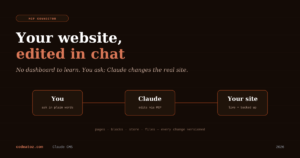
There’s no drag-and-drop editor to learn. You build the store the way you’d brief a developer — in plain English — and Claude does the work through the connector:
| You say | What Claude does | Result |
|---|---|---|
| “Add Trail Boots, £139, 40 in stock” | Creates the product with price and stock | Live on the storefront immediately |
| “Group the boots into a Footwear collection” | Defines a collection and assigns products | A browsable category page |
| “Make a landing page for the winter sale” | Assembles blocks into a new page | A published, styled page |
| “Set up a payment link for this order” | Generates a payment link | A checkout you can send or embed |
Because the site is hosted and published from day one, there’s no “go live” step to dread — each change appears on your real Claude CMS online store as it’s made, and the platform backs up every file before it overwrites it, so nothing is a one-way door.
Hosting and Delivery for Your Claude CMS Online Store
Claude CMS hosts your store for you — there’s no separate server to provision. Pages are served fast and cached at the edge, images lazy-load, and the HTML is clean and semantic so it works for shoppers and crawlers alike.
- Hosted and served on the platform at a Claude CMS address, so you’re not managing infrastructure.
- Edge-cached pages for speed, with assets optimised out of the box.
- Headless delivery is available when you want to serve content to a custom front end or app, rather than the hosted pages.
- Backed-up and reversible — file snapshots mean any change can be rolled back.
If you want the full architecture context, our headless CMS ecommerce stack guide covers how headless commerce fits together, and managing a site with Claude explains the connector that drives it all. Speed is an SEO factor too — our Claude CMS SEO guide covers how the platform’s Core Web Vitals defaults help.
Where a Claude CMS Store Fits (and Where It Doesn’t)
An honest placement, because no platform is right for everything. A Claude CMS online store shines when speed of setup and low operational overhead matter most:
- Great for: launching fast, small-to-mid catalogues, content-led stores, and owners who’d rather describe changes than manage an admin panel.
- Consider a specialist platform for: very large catalogues, deep marketplace integrations, or complex B2B pricing rules, where a mature ecommerce platform’s ecosystem earns its keep.
- Not either/or: many businesses run a Claude CMS site for marketing and a specialist store for a huge catalogue, or start on Claude CMS and migrate as they scale.
If you already run AI-driven WordPress or a WooCommerce store, the same conversational approach is what makes Claude CMS feel different — the platform, not just a plugin, is built around it.
Getting Started With Your Store
- Create a site on Claude CMS and connect it to Claude
- Describe your first products — name, price, stock
- Group them into collections for browsable categories
- Build product and landing pages from the block library
- Set up payment links and test a checkout
- Check the built-in reports for best-sellers and revenue
- Point a custom domain at it when you’re ready to grow
Want a Claude CMS online store set up properly — catalogue structured, pages designed, payments and reporting wired up? That’s exactly the kind of build our CodeAtoZ team does. We’ll get your store live on Claude CMS and shaped around how you actually sell, or help you migrate an existing catalogue across.
Frequently Asked Questions
What is a Claude CMS online store?
It’s an ecommerce store built and run on Claude CMS, an AI-native hosting platform where you manage everything by talking to Claude. Instead of a theme and an admin panel, you describe products, collections, stock and pages in plain English, and Claude creates them through a connector on a storefront that’s live from day one, with payments and built-in reporting included.
Do I need to know how to code to build a store on Claude CMS?
No. The whole point is that you brief Claude in plain English — “add this product,” “make a sale page” — and it does the work. You don’t touch a page builder or write code. A developer or an agency like CodeAtoZ adds value for structuring a large catalogue, custom design, or migrating an existing store, but the day-to-day running needs no code.
Is a Claude CMS store really live from day one?
Yes. The site is hosted and published on the platform from the start, so there’s no separate build-and-launch phase. Each change — a new product, a new page — appears on your live storefront as it’s made. Because every file is backed up before it changes, you can experiment on the live site and roll back anything you don’t want to keep.
Can Claude CMS handle payments and stock?
Yes. A Claude CMS store supports products with stock levels, multiple warehouses, collections, and payment links with payment-status tracking, plus built-in reports for best-sellers and revenue by date range. You manage all of it by asking Claude. For complex tax, shipping or B2B pricing rules, a specialist ecommerce platform may still be the better fit.
Is a Claude CMS online store good for SEO?
It has a solid foundation: pages are edge-cached for speed, images lazy-load, and the HTML is clean and semantic so search engines read your real content. It also includes cookieless analytics. SEO still depends on your content, keywords and links — the platform removes technical barriers but doesn’t rank you automatically. Our Claude CMS SEO guide covers how to make the most of it.
Should I use Claude CMS or WooCommerce/Shopify for my store?
It depends on your priorities. Claude CMS is excellent for launching fast, small-to-mid catalogues, and owners who prefer describing changes over managing an admin. Mature platforms like WooCommerce or Shopify suit very large catalogues, deep integrations and complex pricing. Many businesses use both — or start on Claude CMS and migrate as they scale. We can advise honestly on which fits you.
Want your Claude CMS store built around how you sell?
We’ll structure your catalogue, design your product and landing pages, wire up payments and reporting, and get your store live on Claude CMS — or migrate your existing store across.